

Cat Puzzle Toys vs. Puzzle Feeders: Which Keeps Cats Busy Longer?
A cat puzzle feeder makes your cat work for their food. A cat puzzle toy makes your cat work for a reward. Both are designed to challenge a cat's mind and tap into natural instincts, but they behave differently once your kitty figures them out. Puzzle feeders are tied to meals and naturally portion-limited. Puzzle toys can be used between meals and rely on treats or small amounts of kibble. If your goal is making dinner last longer, pick a feeder. If your goal is adding another enrichment session, pick a puzzle toy. Indoor cats often experience boredom without mental stimulation, and both options help fill an otherwise empty day. At Cidero & Co., we design enrichment toys, slow feeders, and interactive play items for exactly this kind of problem. Concrete product examples are coming later in this article.
Puzzle Toy vs. Puzzle Feeder: What's the Difference?
A cat puzzle feeder (sometimes called a food puzzle) is a device that forces your cat to sniff, paw, or manipulate their way to a regular meal. A cat puzzle toy is a standalone item that dispenses treats or small rewards during play, independent of set feeding times.
Here's a quick comparison:
|
|
Puzzle Feeder |
|
|---|---|---|
|
Main purpose |
Play and mental stimulation |
Mealtime enrichment |
|
Reward |
Usually treats or small kibble portions |
Your cat's regular food |
|
When to use |
Any time of day |
Around meals |
|
How often |
Flexible |
Limited by feeding schedule |
|
Best for |
Extra activity between meals |
Slowing down eating |
Cat puzzle toys require using paws, nose, and brain to unlock food rewards. Puzzles mimic the natural search, chase, and catch cycle of outdoor hunting. Puzzle feeders activate a cat's natural foraging instincts and belong in the "mealtime enrichment" category, while puzzle toys live in the "extra play" category. Neither automatically keeps a cat busy longer; each shines in a different situation.
Which Keeps a Cat Busy Longer?
Puzzle feeders extend how long your cat spends eating. Puzzle toys extend how many engaging moments your cat has across a full day. Cats can spend up to 12 hours hunting in the wild daily, and cats in the wild catch up to 12 rodents daily. Indoor life compresses all that activity into a few minutes of eating from a bowl. Both puzzle types push back against that compression, but in different ways.
Consider a cat alone from 9 a.m. to 5 p.m. Without enrichment, breakfast takes about three minutes. With a slow feeder, that same meal might last 10 to 20 minutes. Add a puzzle toy loaded with a few treats at midday, and you create another 5 to 10 minutes of cat enrichment. Puzzle toys provide mental stimulation and prevent cognitive boredom during the hours between meals.
Puzzle Feeders Can Make Meals Last Longer
A cat puzzle feeder or slow feeder changes eating from "gulp and go" to a process of sniffing, pawing, and manipulating. Feeding puzzles help indoor cats exhibit natural behaviors they'd otherwise never practice. Puzzle feeders slow down a cat's eating pace, which helps cats prone to vomiting or bolting food. Puzzle toys help slow down fast eaters, preventing gulping behaviors. Some puzzle feeders hold up to half a cup of food, turning a three-minute dry food meal into 10 to 20 minutes of active problem-solving.
Once the daily ration of kibble is gone, the enrichment session ends. That's the natural limit of feeders. For wet food, flatter options like lick mats work better. LickiMats are ideal for serving wet cat food. They offer shorter but still meaningful sessions where a cat has to slow down and lick rather than gulp. Puzzle feeders slow down eating and promote mental stimulation, but they're bounded by portion size.
Puzzle Toys Can Create Extra Play Sessions
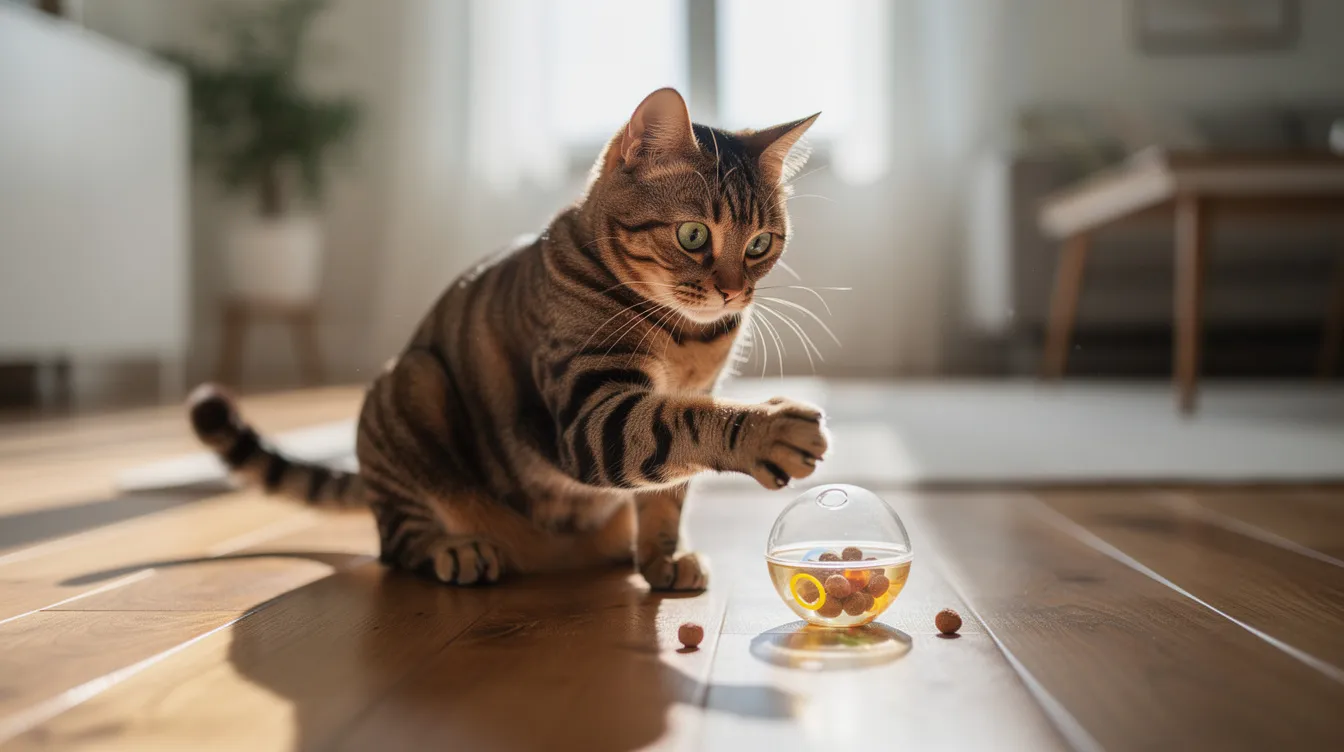
Cat puzzle toys that use treats or small amounts of kibble (treat balls, tumblers, burrow toys) aren't limited to breakfast and dinner. You control both timing and intensity. Run a five-minute session with a treat-dispensing toy while you watch TV at 7 p.m., and you turn a passive evening into an active one. Puzzle toys can turn part of a cat's daily kibble ration into an enrichment activity without adding extra calories.
Treat quantity still matters. Puzzle toys aren't an excuse for unlimited snacks. Subtract whatever you load into the toy from the day's food allowance. Hiding food around the house promotes hunting instincts and engages cats' natural foraging behavior. Frequent short games can reduce indoor cat boredom and help meet cats' hunting instincts. Cat puzzle toys transform mealtime into an active hunt, reducing boredom and anxiety. The core comparison: puzzle feeders extend mealtime; puzzle toys extend the number of engaging moments in a cat's day.
The Biggest Mistake: Making the Puzzle Too Hard
Your cat sniffs the new puzzle, bats it once, looks confused, and walks away. That's the most common reason people feel like they wasted money. The fix is simple: start at the right difficulty and build up. Puzzle toys should be challenging but not frustrating for pets. Easier puzzles kept at the right level keep cats busy longer than overly complex ones they avoid.
Start with an Easy Win
Set puzzles to beginner mode. Leave larger openings on a cat puzzle feeder. Place treats visible on top of a food puzzle. Leave a few pieces of dry food loose around a slow feeder before tucking more pieces deeper inside. In the first few sessions, your cat should get a reward with minimal effort; that builds the idea that interacting with this thing pays off. Even a clever, food-motivated kitten needs this confidence-building phase. It usually takes just a few attempts.
You can also practice with items you already have. A shoebox can be transformed into a cat puzzle feeder. Cats can hunt for food hidden in tissue paper-filled boxes. Cardboard egg boxes can be used for cat food puzzles, and toilet roll tubes can create a pyramid-shaped cat toy. DIY cat toys can help prevent boredom in indoor cats while you teach your cat that puzzles are fun.
Increase the Challenge Gradually
Once your cat confidently empties the puzzle several times in a row, make it a bit harder. Smaller openings, more compartments, or less obvious treat placement. The best puzzle toys feature adjustable difficulty levels for skill progression.
A few concrete ideas:
- Rotate pieces to new positions so the cat has to explore from a different angle.
- Add one extra layer or cover half the openings.
- Mix in a few empty pockets to increase search time.
Cat puzzle toys can be rotated to maintain interest and engagement. Difficulty should increase in small steps over days or weeks, not all at once. Watch how long your cat stays focused at each new level. A mild increase in effort is good. Constant failure is not.
Know When You've Gone Too Far
Signs a cat puzzle or food puzzle is too hard:
- Sniffs and walks away within seconds
- Repeatedly paws the same spot without success
- Vocalizes in frustration
- Stops trying after two or three attempts
If you see these, step difficulty back one level, make rewards more obvious again, or check whether your cat might be ignoring the toy for other reasons. The goal isn't to make the puzzle difficult. It's to make it satisfying. A slightly-too-easy puzzle your cat actually uses will keep them busier over weeks than an "expert level" toy gathering dust on a shelf.
Which Puzzle Is Right for Your Cat?
Different cats prefer different jobs. Some love digging and searching. Others want to bat and pounce on moving things. Matching the puzzle to your cat's instincts (and your goals) makes all the difference. All the examples below use pet-safe materials designed for indoor cats in modern homes.
If Your Cat Loves Exploring and Digging
The Cidero & Co. Carrot Burrow is built for cats that enjoy searching with their paws and noses. You can tuck dry food or treats into the plush "carrots" and pockets, turning a simple play session into a mini food puzzle that rewards digging and investigating. This style keeps an average indoor cat busy for multiple short sessions across the day, especially when rotated with other enrichment items. It also looks good in a small apartment, which matters if your house doubles as your office.

If Your Cat Likes Batting and Chasing
The Cidero & Co. UFO Treat Tumbler suits cats that love to tap, chase, and pounce. Cats use sliding, batting, and fishing motions to access treats in puzzle toys like this one. Batting the UFO-shaped toy around the floor slowly releases kibble, encouraging both physical exercise and problem-solving. Treat mazes challenge paw dexterity and hand-eye coordination. Adjust how many treats you load to manage calories, using part of your cat's normal daily food allowance.

If Your Cat Needs Something Completely Different
The Cidero & Co. Cloud Whack a Mole relies on quick reactions and surprise rather than food. This type of interactive challenge works well for cats that aren't strongly food-motivated or that already get plenty of puzzle feeding but still crave fast-paced play. "Puzzle" enrichment doesn't always have to involve food; it can also mean figuring out where movement will pop up next. Experiment with a couple of formats to find what keeps your individual cat busy longer.

What About Snuffle Mats and Foraging Mats for Cats?
A snuffle mat is another form of food puzzle, originally popular with dog owners but increasingly used as cat enrichment too. Snuffle mats encourage searching behaviors similar to outdoor scavenging. They're closer to cat puzzle feeders than toys: the reward is almost always dry food or treats hidden within fabric strips or pockets. They encourage sniffing, searching, and pawing, which can appeal to scent-driven or slightly anxious cats. Feeding puzzles help prevent boredom in indoor cats this way.
Snuffle mats act like flat, flexible slow feeders. But if your primary goal is active chasing, pouncing, or interactive play, a mat won't fill that role. Wet food generally does not work well in traditional snuffle mats due to mess and hygiene issues; use a lick-style mat for wet food instead.
So, Should You Get a Puzzle Toy or Puzzle Feeder?
Choose a cat puzzle feeder if your cat eats too fast, needs help with portion control, or you want to build enrichment into something you already do twice a day.
Choose a puzzle toy if your cat seems restless between meals, meows for attention during work calls, or needs extra outlets for hunting, batting, and problem-solving. Cat puzzle toys keep indoor felines active and mentally sharp. Interactive toys encourage physical activity and help with weight management. Puzzle toys reduce unwanted behaviors by engaging cats in structured problem-solving. A 2026 randomized controlled trial with 92 indoor cats found that both food puzzles and non-food toys reduced attention-seeking behaviors over four weeks.
Many homes benefit from both. Use a food puzzle or slow feeder for breakfast and dinner, then a cat puzzle toy in the afternoon or evening as a separate session. If you're figuring out how to entertain a cat when you're not home, starting with one high-quality item and layering in a second piece is generally better than buying several underused toys at once.
Best Way to Introduce a Puzzle Toy to a Cat
Three steps work for any new cat puzzle, feeder or toy:
- Make it easy. Begin with obvious rewards and short sessions so the cat quickly learns that interacting with the item leads to food or fun. Sprinkle a bit of kibble right on top where it's visible.
- Reward the interaction. Pair the puzzle with high-value treats (or regular kibble if your cat is food-motivated). Stay nearby and watch calmly to keep the cat feeling safe and encouraging curiosity.
- Increase difficulty slowly. Once the cat confidently solves the puzzle, make small, gradual tweaks. Don't throw a creative new obstacle at them every day.
A puzzle that your cat actually solves every day is more valuable than a "genius-level" toy they never touch.

Final Verdict: Puzzle Toy or Puzzle Feeder?
Puzzle feeders enrich meals and slow down eating. Puzzle toys fill the open hours between meals with play and mental challenge. Indoor cats benefit most from a combination: mealtime enrichment via a cat puzzle feeder plus at least one dedicated puzzle toy for daily enrichment.
Make boredom harder to find. The Carrot Burrow (~$39.99) combines foraging, digging, and comfort in one versatile toy your cat can explore daily. For cats that love chasing, the UFO Treat Tumbler offers a lower-priced, motion-oriented alternative. Browse Cidero & Co.'s full collection of enrichment toys to find the right fit for your cat.
FAQs About Cat Puzzle Toys and Puzzle Feeders
Are puzzle feeders better than puzzle toys for cats? They solve different problems. Feeders enrich meals; toys provide additional enrichment outside mealtimes.
Do puzzle toys actually keep cats busy? They can, but engagement depends on the individual cat and whether the difficulty and reward match their motivation level.
Can you put wet food in a puzzle feeder? Some designs (like lick mats or shallow food puzzles) work with wet food. Cardboard DIY toys and many plastic puzzles do not.
Are snuffle mats good for cats? They can be a good option for sniffing and foraging enrichment with dry food, but they won't replace active play.
Can cats use puzzle feeders every day? Yes, as long as portions match the cat's normal diet and you keep the feeder clean and safe.
How difficult should a cat puzzle be? Start easy enough that your cat succeeds quickly, then gradually increase the challenge over days or weeks.


