

Cat Exercise Wheel Alternatives: Cheaper, Smaller Ways to Burn the Zoomies
A full-size cat exercise wheel is an incredible tool, but it's not for everyone. If you live in a compact apartment, cringe at a $300+ price tag, or simply don't have a Bengal cat doing laps at 3 a.m., there are smarter, smaller ways to burn off those zoomies. This guide breaks down exactly when a wheel makes sense, when it doesn't, and what to do instead.
Quick Answer: Do You Really Need a Cat Exercise Wheel?
Here's the honest truth: a cat exercise wheel is the gold standard for a very specific group of indoor cats, mainly high energy cats like Bengals, Savannahs, and Abyssinians that genuinely need long, uninterrupted sprint sessions every single day. For that crowd, a wheel can be transformative.
But for most cats and most homes? It's overkill.
Indoor cats can face health and behavioral hurdles without sufficient exercise opportunities, and cats require mental stimulation to prevent boredom-induced behavior problems. The good news is that you don't need a 48-inch wheel bolted to your living room floor to solve those problems. Many owners get similar zoomie-burning results using cheaper, smaller cat exercise toys, especially in apartments or homes under 800 square feet.
At Cidero & Co., we design compact, instinct-driven enrichment tools for exactly this situation. Throughout this guide, we'll compare wheels fairly against alternatives like our Hunting Spinner, Glow Chase Wand, and environment-based play setups, so you can make the right call for your cat and your space.
When a wheel makes sense:
- You have a bengal cat or similarly high-drive breed that sprints daily
- You've got at least 4 feet of clear wall space and a $150+ budget
- Your cat already shows strong running behavior and loves repetitive motion
When an alternative is better:
- Your apartment is under 800 sq ft or has thin floorboards
- Your cat prefers stalking, pouncing, and hunting over straight-line running
- You'd rather spend $50–$80 on versatile toys than $200–$600 on a single piece of equipment
What Is a Cat Exercise Wheel (and Why People Love Them)?
A cat exercise wheel is essentially a large, circular cat treadmill that spins freely as your cat runs inside it, much like an oversized hamster wheel. Most quality models range from 40 to 52 inches in wheel diameter, sit on a sturdy base, and weigh anywhere from 25 to 50 pounds.
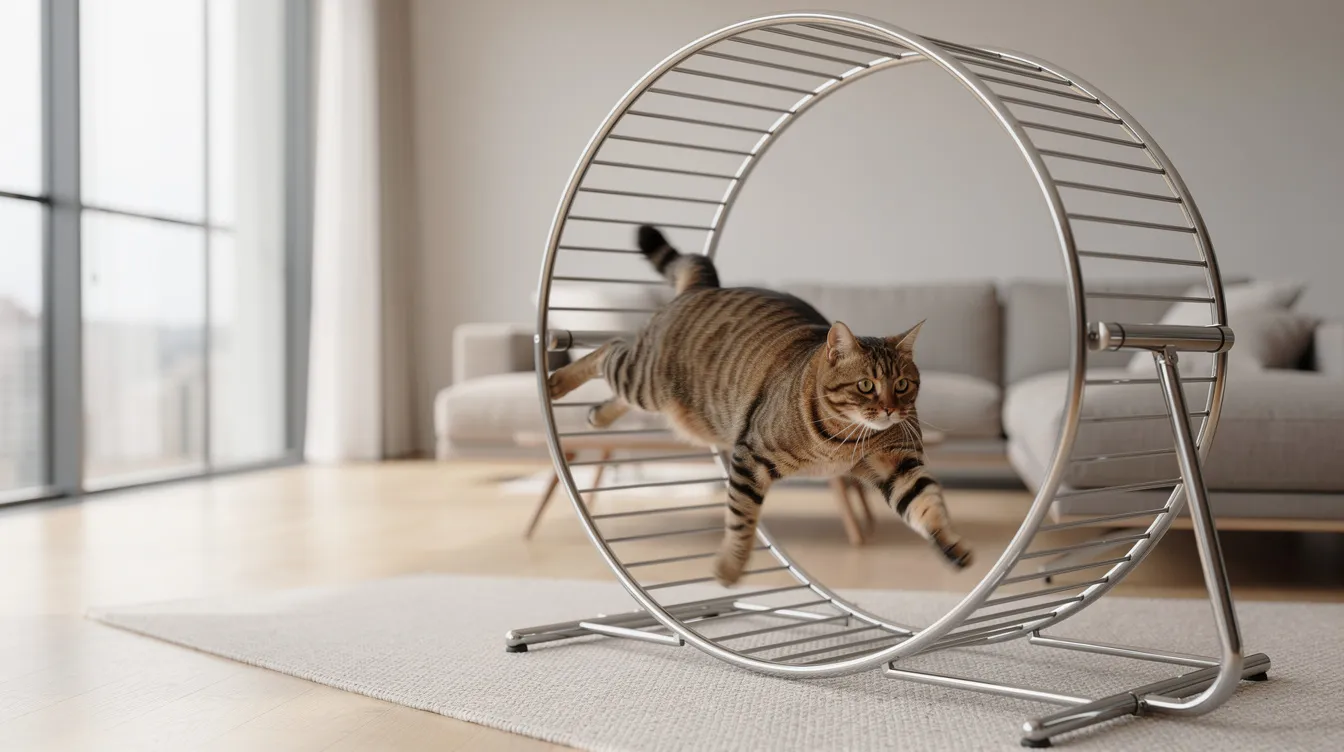
When a cat starts running on the wheel, the motion mimics outdoor sprinting. The wheel spins at the cat's own pace with no motor involved, which means the cat controls the speed entirely. Popular models include the One Fast Cat Wheel (48-inch diameter, supports cats up to 26 pounds, made from recyclable ABS plastic), the Ferris Cat Wheel (over 48 inches, known for quiet operation), and the GoPet Cat Treadwheel which supports up to 50 pounds and targets larger or overweight adult cats.
Cats enjoy wheels that mimic their natural hunting, chasing, and sprinting instincts. Here's why owners invest:
- Intense cardio for a fast cat that needs daily sprint sessions
- Mental stimulation through repetitive, rhythmic movement
- Cat exercise wheels help indoor cats burn excess energy and maintain a healthy weight
- Exercise wheels reduce stress and anxiety in cats, especially those with pent-up energy
- Regular use of a cat exercise wheel can support healthy weight and cardiovascular conditioning
- A wheel can be an outlet for high energy cats, reducing destructive behavior like scratching furniture or ambushing ankles
When a Full-Size Cat Exercise Wheel Actually Makes Sense
Not all cat wheels are created equal, and not all cats need one. But for specific households, a running wheel is genuinely the best solution. Here's how to know if you're in that group:
- You have a high-drive breed. Bengals, Savannahs, Abyssinians, and some Siamese cats naturally perform repeated sprint bursts. These energetic cats can log serious distance on a wheel daily. Cats can lose weight and gain muscle using exercise wheels when they use them consistently.
- Multi-cat household chaos. If one or two cats are constantly pacing, vocalizing at night, or triggering destructive midnight zoomies despite routine play, a wheel gives them a self-service outlet.
- Behavioral red flags are present. Repeated 3 a.m. zoomies, ambushing ankles, obsessive window watching, or constant door-dashing attempts all point to unmet energy needs that a large wheel can address.
- You have the space and budget. At least 4 feet of clear floor space against a wall, willingness to spend $150–$600, and patience for the training period.
For these cats, repeated sprints on a large, smooth, quiet exercise wheel prevent frustration, support weight management, and give them the physical outlet they're wired for.
Why Many Homes Struggle With a Cat Exercise Wheel
Cat wheels look great in Instagram videos. Living with one is a different story. Here are the practical friction points that trip up most buyers:
The footprint alone is significant. A wheel with a 48-inch diameter needs roughly 4 to 5 feet of clear wall space, plus room behind and beside it for your cat to enter and exit safely. In studios or living rooms under 500–600 square feet, a cat wheel dominates the room visually and physically.
- Floor space and bulk. Even mid-size models occupy a 4×4-foot zone. That's a meaningful chunk of a one-bedroom apartment.
- Price. Entry-level plastic wheels start around $120–$150 on sale. Mid-range wood models run $200–$350. Premium pre assembled wheels with quiet operation climb to $400–$600 or more. Compare that to $30–$60 for a high-quality interactive cat toy.
- Noise. On older floorboards or thin-walled apartments, roller bearings create low-frequency rumble and vibration. When a fast cat hits full speed at midnight, downstairs neighbors feel it.
- Training is time consuming. Most cats don't jump on a wheel and start running. It can take days to weeks of treat-based training before they use it purposefully. Many expensive wheels end up as expensive cat beds.
- Personality mismatch. Not every cat is a runner. Some prefer climbing, stalking, puzzle feeding, or bird watching. A cat wheel for a non-runner is just furniture with a curve.
Cat Exercise Wheel vs Alternatives: Who Wins on Space, Cost, and Effort?
Let's put wheels and compact alternatives side by side on the factors that actually matter for most indoor cat owners.
Space:
- A cat wheel needs roughly a 4×4-foot clear area with wall backing. It stays there permanently.
- Compact cat exercise toys like hunting spinners, chase wands, and tunnels store in a drawer, closet, or under the sofa. They work in a narrow hallway or diagonally across a studio.
Price:
- Typical wheel range: $120–$400 for decent quality. The best cat exercise wheels (quiet, durable, well constructed) often land at $300–$600. Cat exercise wheels can support cats up to 25 pounds, but going bigger for large cats pushes costs even higher.
- High-quality interactive toys: $20–$80 per piece. The Cidero & Co. Hunting Spinner runs $53.99 in 2026. A full enrichment kit (spinner, wand, tunnel, slow feeder) totals roughly $120, the same price as a single budget wheel.
Owner effort:
- Wheels require multi-week training commitments. Indoor exercise wheels can provide structured exercise in small living spaces, but only after your cat actually learns to use one.
- Compact toys for cats that like to hunt produce near-instant engagement. A 5–10 minute daily play session with a chase toy gets most cats sprinting, pouncing, and satisfied without weeks of setup.
Movement quality:
- Wheels offer continuous linear cat running. Great for endurance, but it's one movement pattern.
- Chase and spinner toys deliver sudden direction changes, zigzags, pounces, and leaps. They trigger the full predatory sequence: stalk, chase, pounce, catch. Wand toys add vertical jumps and mid-air twists.
Are Cat Exercise Wheels Safe and Comfortable for Most Cats?
Choosing the right exercise wheel requires considering size, stability, and safety features. Here's what to look for if you do go the wheel route:
-
Minimum size. The best cat wheels should be at least 40 inches in diameter. Cat wheels should be large enough to allow cats to run comfortably without curving their backs. A 48-inch diameter wheel allows cats to run comfortably for most adult cats. While cat wheels should have a minimum diameter of 19 inches (for very small breeds or kittens), anything under 38–40 inches forces most cats to arch their spine, tuck their tail, or look hunched during sprints.
- Running surface. The running surface should be smooth to prevent claw snags. A wheel should have a non-slip tread to prevent slipping and reduce injury risk. Foam traction pads are made from formamide-free EVA foam and provide excellent grip without catching a cat's claws. Avoid fully slick plastic with no traction, and avoid rough carpet that can trap claws.
- Stability. Look for a sturdy base that doesn't wobble under full-speed running. A stable base with sturdy construction and adequate weight prevents tipping, especially with larger cats. Safety features such as enclosed tracks help protect cats during use.
- One cat at a time. Multiple cats should never use the wheel simultaneously due to collision risk. Most detailed instructions specify single-cat use only.
- A safety latch or lock on the wheel when not in use prevents uncontrolled spinning that could startle nearby pets or kittens.
Small wheels under 38–40 inches may seem like a space-saving bargain, but they can cause spinal stress in adult cats. Size is a safety issue, not just a comfort preference.
Training a Cat to Use a Wheel: Timeframes and Reality Check
Training a cat to use a wheel typically takes 2–3 weeks for most cats. But that's the optimistic average. Here's what the process actually looks like:
Typical training steps:
- Let the cat explore the stationary wheel with the lock engaged. No pressure, no forcing.
- Place treats or cat food on the wheel surface while it's still locked. Let the cat step on, eat, and step off.
- Introduce a feather wand or toy to lure the cat onto the wheel while locked.
- Unlock the wheel and use treats to coax the cat into slow walking. Using treats can help coax cats onto the exercise wheel during this phase.
- Gradually increase distance and speed as the cat gains confidence.
Realistic timeframes:
- Bold, young cats may walk within 2–3 days
- Average adult cats: 2–3 weeks of consistent daily sessions
- Stubborn cats may take longer to train on the wheel
- Some cats may need months to use the wheel independently
- A meaningful percentage never adopt the wheel at all
Daily training sessions should last about 5–10 minutes. Positive reinforcement is important in teaching cats to use an exercise wheel, and forcing a cat onto the wheel can backfire, creating lasting fear of the device. Introduce a cat to the wheel gradually to minimize stress and fear, and monitoring for signs of stress is important during initial sessions with an exercise wheel. Compare this to a compact chase toy where you unbox it, turn it on, and most cats are sprinting within minutes. The training gap is significant.
Three Compact Alternatives That Still Create "Sprint" Sessions
The real goal isn't owning a specific piece of equipment. It's giving your cat regular opportunities for intense, short bursts of cat running and pouncing that satisfy their predatory instincts and keep them healthy.
Here are three alternatives that deliver that outcome in a smaller footprint and at a fraction of the cost:
- Alternative #1: Hunting Spinner - a compact, floor-safe spinner that triggers high-speed chases and sharp directional changes
- Alternative #2: Glow Chase Wand - a manual wand with a glowing lure for vertical and horizontal sprint play
- Alternative #3: A "500-Square-Foot Playground" layout - a tunnel-and-furniture loop that turns your apartment into a sprint course without any bulky equipment, drawing on principles from indoor and catio tunnel setups
Alternative #1: Hunting Spinner – Compact Indoor "Sprint Track"
The Hunting Spinner from Cidero & Co. is a compact, floor-safe spinner-style cat exercise toy that sends a prey-like target whipping around in tight circles and arcs, right at ground level where your cat's predatory instincts kick in hardest.
At $53.99 in 2026, it's intentionally positioned as a cat exercise wheel alternative. The footprint is a fraction of a wheel's, it's designed for apartments, and it still triggers high-speed sprints and razor-sharp turns, all features highlighted in the Hunting Spinner Exercise Toy for Cats product overview.

Here's how it works in practice: you activate the spinner, the lure darts unpredictably across the floor, and high energy indoor cats chase, stalk, and pounce in intense 5–10 minute bouts. Most cats engage immediately with no training period required.
Compared to wheels, which create linear running in one direction, the Hunting Spinner adds hunting-style zigzags that promote both cardio and predatory satisfaction. That matters because cats love the full stalk-chase-pounce sequence, not just straight-line endurance running, and a comprehensive guide to cat spinner toys can help you tailor that play to your cat's age and personality.
For a deeper look at spinner-style toys and how they fit into daily enrichment routines, check out our guide to interactive cat toys.
How to Use the Hunting Spinner to Replace a Wheel Workout
You don't need a complicated routine. Here's a simple protocol that equals or surpasses the daily run time most cats would get on a wheel:
- Frequency: Two to three short sessions per day, each lasting 5–8 minutes. That's 15–24 minutes of high-intensity play, matching or exceeding what even energetic cats typically do on a wheel.
- Layout tips for small spaces: Set up in a hallway for straight-line dashes. Place it near a coffee table so your cat weaves around legs. In a studio, run it diagonally corner-to-corner for maximum sprint distance.
- Adjusting difficulty: Start on slower speeds or shorter arcs for timid or older cats. Dial up speed and randomness for a fast cat that wants a real chase. The spin pattern keeps things unpredictable, which prevents the boredom that kills interest in static toys.
- End with a catch and reward: Let the cat "win" by catching the lure at the end of each session, then immediately offer a small portion of cat food or a high-value treat. This simulates the natural hunt–catch–eat–groom–sleep cycle, which improves post-play calm and satisfaction.
The best exercise routine is one your cat actually does every day. A toy that produces instant engagement beats a wheel that sits idle.
Alternative #2: Glow Chase Wand – Vertical and Horizontal Sprint Play
The Glow Chase Wand from Cidero & Co. is a manual but highly flexible exercise wheel alternative for adult cats and kittens alike. Its long reach and glowing lure allow owners to create fast, sweeping patterns across floors, over sofas, and up climbing furniture.
What makes it different from a standard wand? The glow element works brilliantly in dim rooms, triggering the same prey-drive response that makes cats chase moths and light spots. It encourages jumps, mid-air twists, and full-body stretches that a wheel simply can't replicate.
Key advantages over a wheel:
- Combines vertical and horizontal motion in one fun session
- Works in rooms too tight for a large wheel
- Completely silent on floorboards, no vibration, no rumble
- Especially useful for cats that like to hunt flying prey like moths, flies, or moving shadows
- Suitable for both kittens and adult cats, with adjustable movement speed
The Interactive Aquarium Cat Toy Lamp from Cidero & Co. pairs well with wand play, adding passive visual stimulation between active sessions.

Turn Wand Play Into a Structured Cardio Session
Random waving works, but a structured "interval training" approach gets dramatically better results:
- Sprint intervals: 30–40 seconds of intense chase with the Glow Chase Wand, followed by 20–30 seconds of calm petting or stillness. Repeat 6–8 times for a complete session.
- Use furniture as terrain: Drag the lure up a cat tree for short uphill sprints, across a couch for lateral leaps, and down to the floor for controlled pounce landings. This mimics complex outdoor terrain without needing a dedicated wheel.
- Match movement to personality: Slow, sweeping arcs for shy or older cats. Fast, erratic zigzags with sudden stops for high energy cats that want a challenge. Vary the pattern each session.
- Always let the cat win. End every session with a clear "catch" moment where the cat gets the lure. This reinforces confidence and prevents the frustration or overarousal that leads to biting or aggression after play.
Alternative #3: A "500-Square-Foot Playground" Layout Without a Wheel
You don't need a single large piece of equipment. You need a loop.
The concept is simple: reconfigure your existing apartment into a circular play route using tunnels, furniture, shelves, and hideouts. Your cat sprints through the loop during play sessions, getting the same cardio without a wheel taking up permanent floor space.
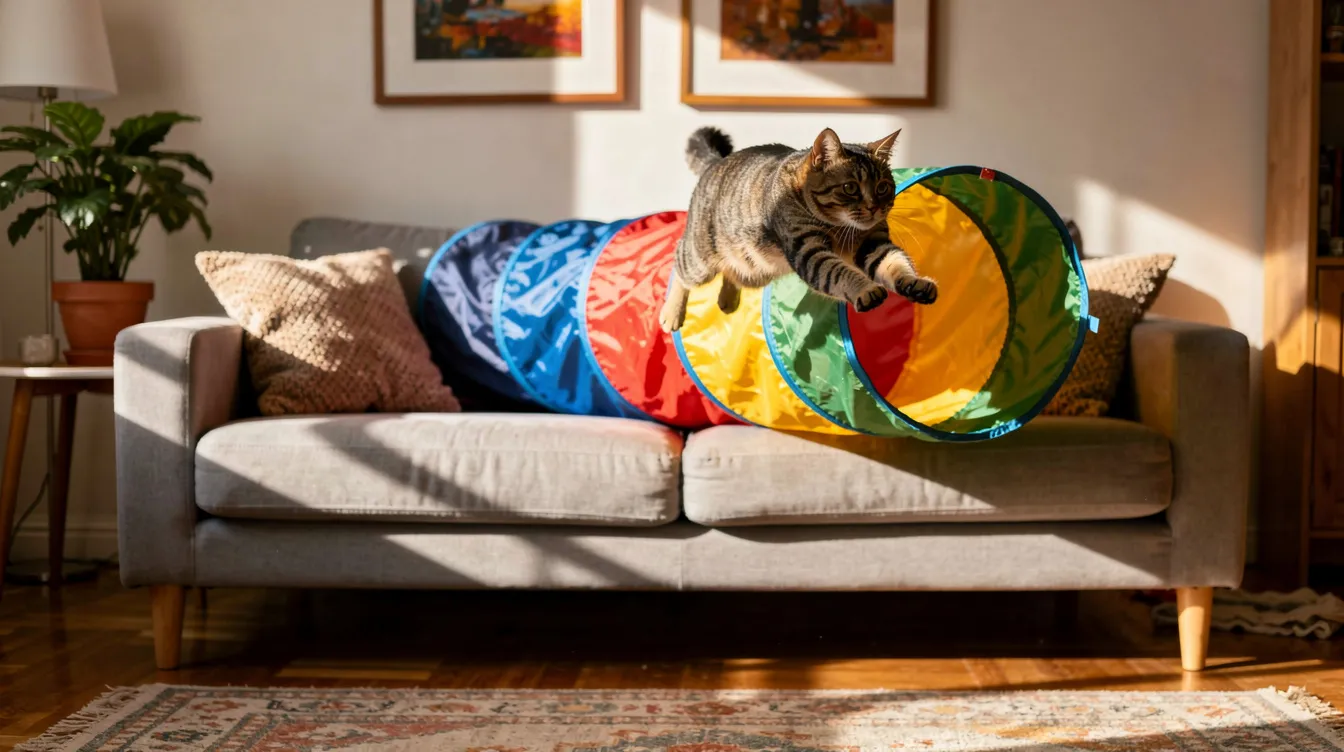
Here's a concrete layout blueprint:
- A fabric tunnel behind the couch. This becomes the "speed zone" where cats dash through at full tilt and taps into the benefits of cat tunnels for indoor cats. Foldable tunnels collapse flat when not in use.
- A low shelf or window perch as a checkpoint. Cats naturally leap up to elevated surfaces during play, adding a vertical sprint element.
- A landing mat or rug as the designated pounce zone. Place a kicker toy or plush prey here for the final "catch."
- A slow feeder or lick bowl at the endpoint to complete the hunt-catch-eat cycle and bring your cat back to calm.
- Rotate stations weekly to keep the route feeling fresh and prevent environmental boredom.
For a deeper dive into this approach, our guide on banishing indoor cat boredom with daily tunnel routines walks through specific setups room by room, and our explainer on why cats actually like tunnels details the instinctive benefits behind this layout.
Types of Cats: Who Thrives With Wheels vs Alternatives?
Cats are individuals and may have unique enrichment preferences; not all will use a wheel. Here's a quick decision guide based on cat type:
- Ultra high-drive breeds (Bengals, Abyssinians, Savannahs): These cats genuinely benefit from a good cat wheel with a large wheel diameter. If you have the space and budget, a wheel gives them the extended solo sprint sessions they crave.
- Playful but moderate-energy mixed breeds: Most domestic shorthairs and longhairs fall here. They get excellent indoor exercise from structured play sessions with compact toys. A wheel is likely overkill.
- Senior cats: Low-impact chase games on soft carpet or slow, predictable spinner patterns are more appropriate than steep wheel acceleration. See our guide on senior cat enrichment for tailored ideas.
- Large cats over 15 lbs: Many standard wheels hit their weight limit quickly. Larger breeds may need the Nordic Beast Cat Exercise Wheel, which is best for large cats, or alternatives that don't have weight constraints, like floor-based chase toys.
- Multi-cat households: A wheel serves one cat at a time. For homes with multiple cats, toys like tunnels and spinners often work better because they accommodate group play dynamics.
If your cat does zoomies every night but ignores laser pointers and wand toys, a wheel might be your answer. If your cat stalks, pounces, and ambushes, compact hunting toys are likely a better fit.
Cost Breakdown: Wheels vs Smart Toy Investment
Let's talk real money using 2026 prices:
Cat exercise wheels:
- Entry-level plastic (e.g., budget models on Walmart): $120–$150. Often smaller breeds only, detachable carpet surfaces that wear quickly, and questionable sturdy construction.
- Mid-range wood or plastic hybrid: $200–$350. Better quiet operation, smoother bearings, available in multiple colors and finishes.
- Premium (Ferris cat wheel, GoPet, custom builds): $400–$850. The one fast cat wheel (One Fast Cat Gen 7) sits around $180–$195, making it a mid-range value. Some cat wheels are made from recyclable ABS plastic, adding environmental appeal.
- Add shipping costs ($30–$80 for oversized items), replacement pads ($20–$40 annually), and potential grip surface replacements.
Smart enrichment kit (comparable daily exercise value):
- Hunting Spinner: ~$53.99
- Glow Chase Wand: ~$30–$40
- Foldable tunnel: ~$25–$35
- Slow feeder or lick bowl: ~$15–$20
- Total: ~$120–$135 for four different activities serving different play styles
The smart kit also has a hidden advantage: if one toy doesn't click with your cat's personality, you've lost $30–$50, not $300. And you can rotate toys to maintain novelty, since research shows cats lose interest in the same toy within 2–3 weeks.
Noise, Neighbors, and Night Zoomies
This one matters more than most buyers expect.
Cat wheels generate low-frequency rumbling, repetitive thuds, and structural vibration that travel through floorboards. Even wheels marketed as "quiet" produce noise when a fast cat hits full stride, especially on wood or laminate floors in older buildings. If you live above someone, midnight zoomies on a wheel become their problem too.
- Wheels at night: Unless you lock the wheel after hours (defeating the purpose of 24/7 access), your cat will use it when predatory drive peaks, typically between 10 p.m. and 5 a.m.
- Compact alternatives are nearly silent. Spinner bases with floor-safe pads, soft wand toys, and plush prey toys produce zero vibration. Your downstairs neighbors won't hear a thing at 1 a.m.
- Scheduling strategy: Do intense exercise 90 minutes before your bedtime using compact toys. This pre-exhausts your cat before the typical midnight zoomies window, reducing both wheel noise and 3 a.m. hallway sprints.
Safety and Supervision: Wheels vs Smaller Toys
Both wheels and compact toys require supervision during high-intensity play. Here's how the risks compare:
Wheel safety watchpoints:
- Tail or paw catching on the outer edge during high-speed running
- Children or dogs attempting to interact with the moving wheel
- Multiple cats jumping on simultaneously (collision risk)
- Very young kittens using oversized wheels unsupervised
- Frame instability in cheaply built models (tipping risk)
Compact toy safety watchpoints:
- Strings on wand toys can entangle if left unattended. Always store wands after sessions.
- Electronic toys need periodic inspection for loose parts or exposed wiring.
- Small detachable lure pieces can be a choking hazard for aggressive chewers.
The bottom line: supervised sessions are recommended for any intense cardio play, regardless of tool. Wheels require extra caution at high speeds due to momentum and the enclosed structure. Cidero & Co. prioritizes pet-safe materials and durable construction across its cat toy range, designed specifically for indoor use and regular play.
How to Decide: A Simple Checklist Before You Buy a Wheel
Before clicking "add to cart" on a best seller wheel you saw online, run through this checklist:
- ✅ Space: Do you have at least a 4-foot wide clear wall section with room behind and beside the wheel? Measure before you buy.
- ✅ Budget: Are you comfortable spending $150+ on the wheel itself, plus $30–$80 for shipping and accessories?
- ✅ Cat personality: Do you own at least one very high-drive cat that already loves to run in long, straight-line bursts (not just pounce-and-retreat)?
- ✅ Training patience: Are you willing to invest 2–3 weeks of daily 5–10 minute training sessions with no guaranteed outcome?
- ✅ Noise tolerance: Is your living situation (and your neighbors' patience) compatible with a large wheel spinning at midnight?
- ✅ Weight check: Is your cat within the wheel's weight limit? The wheel supports cats weighing up to 25 lbs safely for most standard models.
If you answered "no" to two or more of these, start with one or more compact alternatives like the Hunting Spinner or Glow Chase Wand. Reassess in a few months once you understand your cat's exercise preferences.
Integrating Wheels and Alternatives: Not Either/Or
Some households benefit from both approaches. This isn't a binary choice.
- Morning solo time: If you own a wheel and a high-drive cat, let them use it for independent cardio while you're at work or busy.
- Evening bonding play: Use a Hunting Spinner or wand for 10 minutes of structured interactive play in the evening. This satisfies the social and predatory needs that solo wheel running doesn't address.
- Mixing prevents boredom. Any single toy, including a wheel, loses novelty over time. Rotating between wheel days, spinner sessions, tunnel play, and wand games keeps most cats mentally engaged over months and years.
- Weekly rotation strategy: Swap out one or two toys each week. Occasionally lock the wheel for a day and offer new enrichment instead. Keeping the environment dynamic matters more than any individual pet product.
Special Cases: Kittens, Seniors, and Large Cats
Kittens: Growing bones and developing coordination make full-speed wheel running risky for young cats. Short, supervised chases with lighter toys are generally safer and more controllable. A kitten under six months old doesn't need a durable running wheel-it needs varied, appropriately sized play that builds agility without stressing developing joints.
Senior cats: Older cats with arthritis or reduced mobility benefit from clean, low-impact enrichment. Slow, predictable Hunting Spinner patterns on soft rugs, gentle wand movements, and enrichment that doesn't require athletic play are more appropriate than steep wheel acceleration.
Large cats (18–20+ lbs): Many standard wheels cap around 25 lbs. The Nordic Beast Cat Exercise Wheel is best for large cats, and the GoPet Treadwheel supports up to 50 pounds, but both come with premium price tags. For large cats on a budget, floor-based chase toys, environment routes, and tunnels sized for bigger cats are often safer, more affordable, and a good fit for broader body types.
Setting Up Your Home for Daily Cat Exercise (With or Without a Wheel)
Think of your home as a flexible playground that evolves, rather than a space that needs one large centerpiece.
- Hallways are sprint tracks. Use a long hallway for straight-line dashes with a spinner or wand. Even a 10-foot stretch is enough for a full-speed burst.
- Couches are hurdles. Drag a wand lure across the top of a couch to encourage leaping. The height change adds a vertical exercise component.
- Window perches are finish lines. Place a perch or shelf at the end of a play route. Cats naturally gravitate toward elevated endpoints, giving them a "reward" lookout after a sprint.
- Under-bed spaces work as tunnels. If you don't have a dedicated tunnel, low clearance under beds and side tables creates natural ambush zones that cats will use during play.
- Create a loop. Place your enrichment items (tunnel behind the couch, spinner charging spot near the kitchen, wand toy hook by the door, slow feeder on a shelf) so they naturally form a circuit. Your cat will learn the route and start self-directing sprints between stations.
Why Cidero & Co. Focuses on Alternatives, Not Wheels
At Cidero & Co., we build compact, instinct-driven enrichment tools that fit modern indoor living: small spaces, shared walls, and design-conscious homes.
Rather than producing a giant exercise wheel, we chose to invest in versatile toys that combine mental stimulation, hunting play, and physical exercise for most cats. Our product line includes interactive lamps, remote-control chase toys like the Hunting Spinner, tunnels, plush prey, and feeders that slow eating and extend engagement.
We're not anti-wheel. For the right cat in the right home, a well-built wheel is a fantastic tool. But we believe that most indoor cat owners, especially those in apartments, need something more flexible, more affordable, and more likely to actually get used every day. That's where our products live.
Frequently Asked Questions About Cat Exercise Wheels and Alternatives
Do most cats actually use cat exercise wheels? Not all. Many wheels go unused because the cat's personality doesn't match. Cats are individuals with unique enrichment preferences. High-drive breeds tend to adopt wheels more readily, but average domestic shorthairs often prefer hunting-style play over repetitive linear running.
How long should a cat run or play each day? Most vets recommend 15–30 minutes of active exercise daily, broken into two or three sessions. Whether that comes from a wheel, a spinner, or a wand doesn't matter—the consistency matters.
Are exercise wheels good for overweight cats? Yes, when properly introduced. A 2017 study found that wheel access increased voluntary physical activity in cats, though results varied by sex and age. Approximately 58% of adult cats in the USA are overweight or obese, so any tool that gets them moving is valuable. Start slow and consult your vet.
What's the best cat exercise wheel alternative for a tiny studio? The Hunting Spinner from Cidero & Co. It takes up almost no floor space, stores easily, and produces the same intense sprint bouts in a hallway or next to a coffee table. Pair it with a Glow Chase Wand for variety.
Can toys really replace a wheel's benefits? For most cats, yes. The goal is intense, regular physical activity combined with mental stimulation. Compact chase and hunting toys deliver both, often with more movement variety than a wheel's single-direction running.
What about noise in apartments? Cat wheels create vibration and low-frequency rumble on hard floors, especially at night. Compact toys with soft bases and plush elements are virtually silent, making them far more apartment-friendly.
How long does it take to train a cat on a wheel vs. start using a toy? Training a cat to use a wheel typically takes 2–3 weeks of daily sessions. Most interactive toys produce engagement within minutes of unboxing. If you're short on patience or time, start with a toy and consider a wheel later.
Next Steps: Building Your Cat's Personal Fitness Plan
You've got two paths forward, and both are valid:
Path 1: If you truly have the space, the budget, and a high-drive cat that already loves to run, commit to a properly sized, high-quality cat wheel with at least a 40-inch inner diameter, non-slip pads, and a stable base. Train patiently, and complement it with interactive toys for variety.
Path 2: If you're like most indoor cat owners (limited space, moderate-energy cat, neighbors downstairs), start with compact chase and hunting toys. They're cheaper, instantly engaging, and far more versatile.
Try a 30-day experiment. Track your cat's zoomies, scratching incidents, and nighttime disturbances for one week before introducing new enrichment. Then add one or two tools and track the same metrics for three more weeks. The difference will speak for itself.
Ready to start? Browse Cidero & Co.'s collection of cat enrichment products, starting with the Hunting Spinner, Glow Chase Wand, and our foldable play tunnels. Even small changes in daily play can dramatically improve your indoor cat's health and happiness.
Your cat doesn't need a giant wheel. Your cat needs you to show up for 10 minutes a day with something worth chasing.


