

Give Your Forearms a Break: Why Cats Like Kicker Toys?
Has your cat ever grabbed a toy - or your arm - with their front paws and started kicking wildly with their back legs? That move is called a bunny kick, and it's one of the most instinctive things your cat does. It looks dramatic, sometimes hilarious, and occasionally painful if your forearm is the target.
Bunny kicking is completely normal cat behavior. It comes from deep-rooted hunting instincts that every domestic cat carries, whether they live in a barn or a studio apartment. In this article, we'll cover why cats bunny kick, when it's playful versus aggressive, why kicker toys satisfy this instinct so well, and how to pick the right one for your indoor cat.
What Is Bunny Kicking? (Cat Grabs Toy and Kicks With Back Legs)
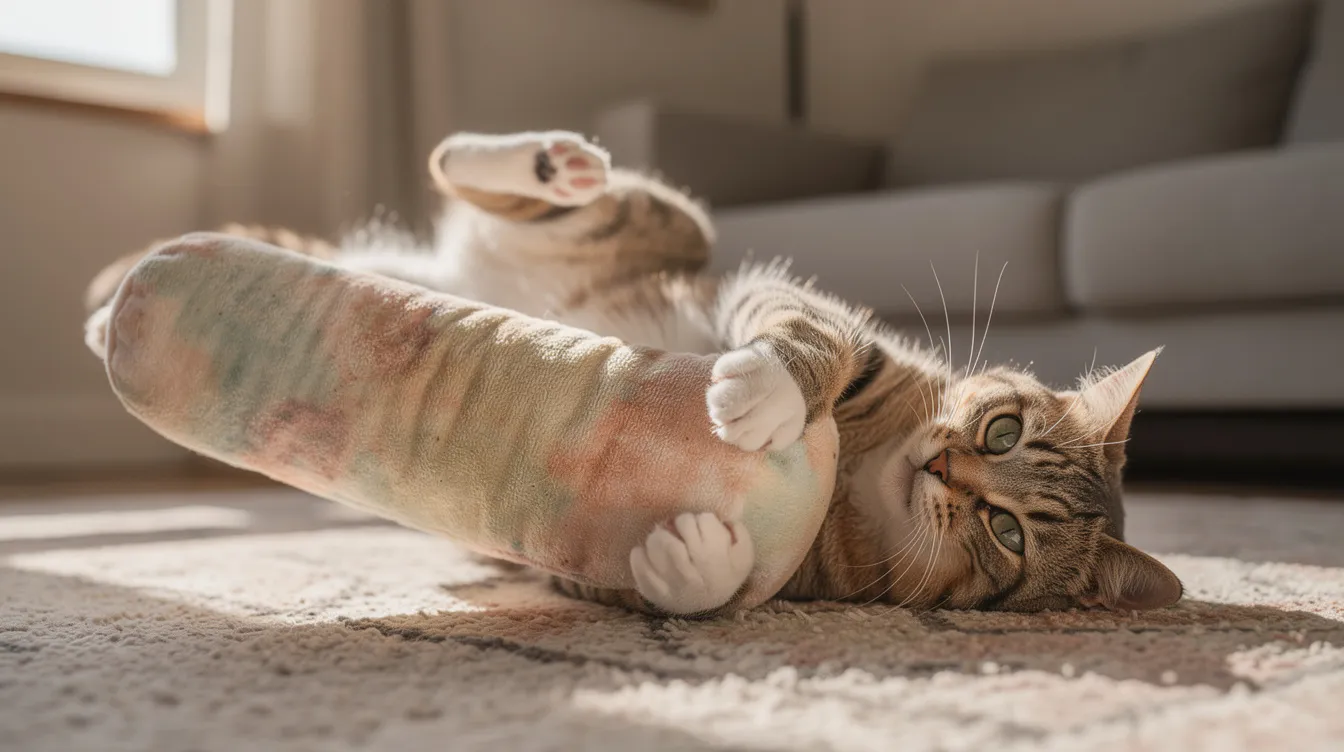
A cat bunny kick looks like this: your cat clamps their front paws around something - a toy, a wrist, another cat - then rapidly pistons both hind legs into it with claws out. The movement lets cats bring all four paws and their sharp claws to bear on a single target. It's a classic hunting maneuver seen in kittens and adult cats alike.
Cats usually do this while lying on their side, which briefly exposes their belly. Many owners mistake this for an invitation to give a belly rub. It's not - it's a fighting position.
Wild and outdoor cats use the exact same motion to subdue small prey. Kicking with the rear legs is a natural behavior in cats that doesn't disappear because they live indoors. Domestic cats simply transfer the instinct to toys, blankets, and occasionally your legs. Cats learn bunny kicking from play with their mothers and litter mates, practicing the move long before they ever see real prey.
Why Do Cats Like Kicker Toys?
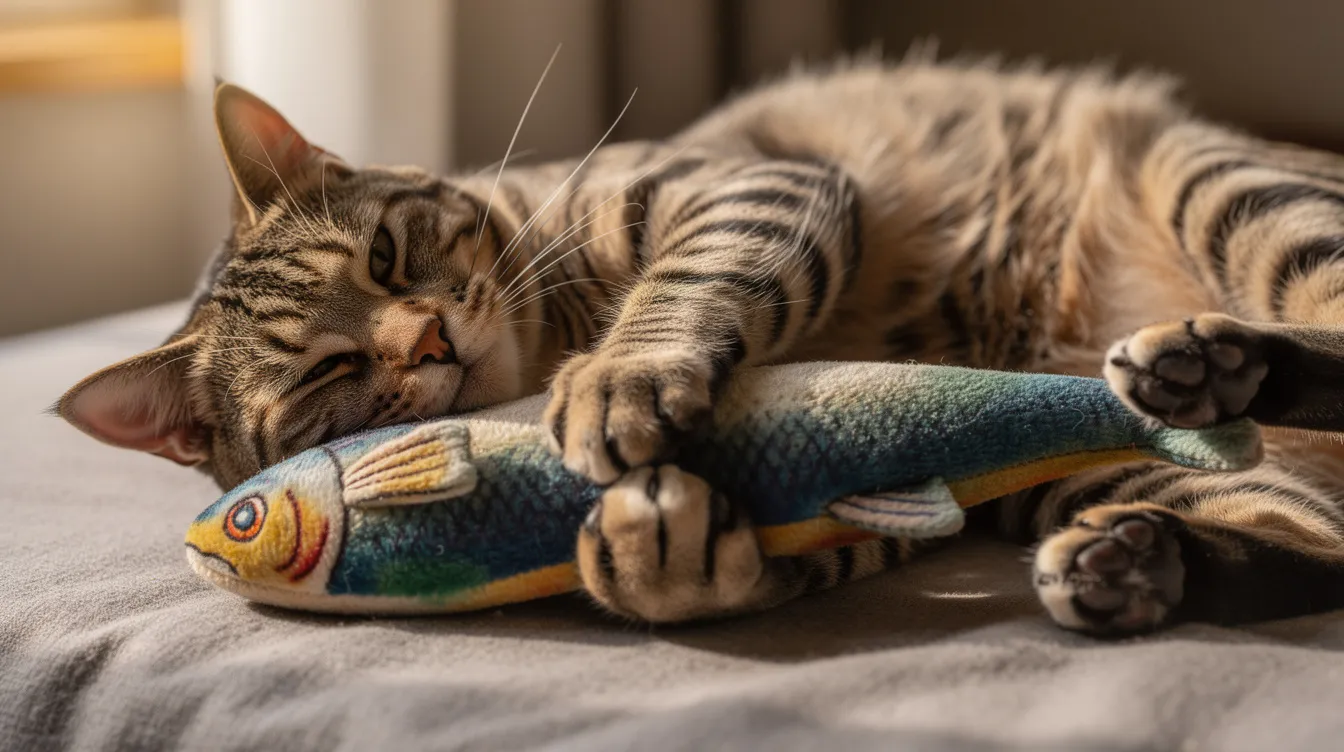
Cats like kicker toys because they're the perfect shape and size to hug, bite, and bunny kick - safely acting out a full hunting sequence. Kicker toys are designed to mimic the final stages of a hunt, giving your cat an appropriate toy to wrestle instead of your arm. Here's why they work so well.
They Mimic Catching and Wrestling Prey
Long, oblong kicker toys resemble the shape of real prey far more than a tiny jingle ball ever could. Kicker toys simulate the feel of large prey, encouraging playful behaviors like grabbing, biting, and rabbit kicking. The size and shape of kicker toys allow for a full wrestling hold - front legs wrapped tight, teeth at the "neck," hind legs delivering rapid bunny kicks.
A 12–14 inch fish-shaped plush like the Jumbo Goldfish Kicker Plush is a good example of this ideal shape. The Jumbo Goldfish Kicker Plush for cats is large and soft enough to encourage full-body wrestling, bunny kicking, and post-play cuddling. When your cat carries it across the room afterward, they're mimicking dragging prey to a safe spot. Kicking a toy mimics how cats fight mice or birds in the wild - and it's deeply satisfying for them.

They Release Built-Up Energy (Especially for Indoor Cats)
Indoor cats build up serious pent up energy, especially around dawn and dusk. High-quality cat kicker toys designed for indoor cats provide physical exercise - a vigorous bunny kicking session can tire a cat out as effectively as several minutes of chase. Kicking engages a cat's core and hind legs, promoting fitness in a way that batting a ball across the floor simply doesn't.
Kicker toys also help cats release pent-up energy and stress, which means fewer zoomies at 3 a.m. and less chaos in general.
They Complete the Natural Hunting Sequence
Most cats only get the "chase" part of hunting from small balls or lasers. The full prey sequence looks like this: stalk → chase → pounce → grab → bunny kick → bite → carry. Kicker toys finally let indoor cats perform the grab-and-kick stages that tiny toys skip entirely.
When a cat is fully engaged - clutching, biting, and cat bunny kicking a toy - they're expressing healthy, instinctive cat behavior. Kicker toys are ideal for satisfying hunting instincts that house cats and pet cats still carry from their wild ancestors.
They Help Reduce Boredom and Frustration
Boredom in indoor cats can lead to problem behaviors: attacking ankles, aggressive play with other cats, chewing cords, or picking play fights with dogs or pets sharing the household. Kicker toys can help prevent boredom and mitigate unwanted behaviors by giving your cat something to wrestle solo.
This is especially helpful in single-cat homes, though they work well in multi cat households too. Interactive toys promote mental stimulation and healthy activity. Rotating a few kicker toys - some with catnip, some without - keeps the novelty high.
Why Do Cats Bunny Kick? (Play, Hunting, Overstimulation & Defence)
The bunny kick shows up in several different contexts, and the movement looks nearly identical each time. What changes is the cat's body language, intensity, and intent. Understanding these differences helps you decide when to grab a kicker toy, when to back off, and when to simply give your cat space.
During Play
Relaxed, wiggly bunny kicks during play are completely normal and even desirable. Bunny kicking is a normal part of cat play behavior. Kittens learn hunting skills by practicing on their litter mates, figuring out how hard is too hard, then transferring those moves to stuffed animal toys and plushes as they grow into adult cats. Channel this kind of playing onto long kicker toys instead of hands or loose sleeves.
During Hunting-Style Play
When a cat stalks, pounces, and then cats kick a toy with full intensity, they're acting out a hunting maneuver in the safest way possible. This is usually more focused than casual play - narrow pupils, very still body, then an explosive pounce. Using wand toys to "deliver" a kicker toy so the cat can catch it simulates a full hunt from start to finish. Redirect bunny kicks to appropriate toys during these sessions for the best results.
During Overstimulation
A cat may be happily accepting petting, then suddenly grab your arm and start bunny kicking. This usually means they're over stimulated - especially from touching the cat's belly or the base of the tail. Bunny kicking can indicate overstimulation in cats. Watch for early signals: tail twitching, skin rippling along the back, ears turning sideways, or a quick head turn toward your hand.
Monitor body language to prevent overstimulation. When you see those signs, pause petting and redirect that energy toward a kicker toy instead of pushing your cat's tolerance.
During Self-Defence
When a cat feels trapped - picked up against their will, held for nail trims, or cornered by another animal - they may roll onto their side and bunny kick as a last-resort self defense. In these moments, claws are fully out, ears are flat, and the cat is trying to create distance. A big cat or a small kitten will do the same thing. Give them space. Don't punish. Cats use bunny kicking as a defensive behavior, and respecting that keeps everyone safer.
Is Bunny Kicking Aggressive or Just Playful?
Bunny kicking itself isn't automatically an aggressive move. Context matters more than the kick itself. Here's a quick comparison:
|
Playful Kicks |
Aggressive Kicks |
|---|---|
|
Relaxed ears, loose body |
Flattened ears, tense body |
|
Soft bites, play biting |
Hard bites, hissing or growling |
|
Takes breaks, re-engages |
Doesn't disengage, escalates |
|
Cat rolls and wiggles |
Cat's body language is stiff |
Stop play immediately if your cat becomes aggressive. Most cats give clear warnings before crossing the line - learning to read those signals is the difference between fun and scratches.
Why Does My Cat Grab My Arm and Kick It?
This is the most common complaint: a cat suddenly grabs a wrist or forearm and unleashes full bunny kicks with sharp claws. The reasons are straightforward - lack of suitable toys, being taught to wrestle hands as a kitten, excess energy, or being over stimulated during petting.
This isn't spite. It's misdirected hunting play. Avoid using hands or feet as play objects - ever. Providing appropriate toys prevents cats from using hands as playthings. Stuffed animals and well-chosen kicker toys that stop bad behavior can help redirect aggressive play behavior, and understanding how kicker toys stop bad cat behavior and how to pick the right one makes it easier to choose options your cat will actually use.
When it happens: freeze, gently withdraw, and immediately offer a long kicker toy. Using kicker toys can redirect cats' tendency to bite or scratch human body parts. Establish daily play sessions with suitable cat toys so your hands are never the most exciting option in the room.
What Makes a Good Kicker Toy?
Instead of just saying "buy a kicker toy," here's how to actually choose one that works. Kicker toys provide a safe outlet for rough play, but only if they're the right size, weight, material, and properly safety-checked for your cat.
Length: Long Enough to Hug and Kick
Most cats prefer a kicker toy roughly the length of their body - about 10–14 inches for an average adult cat. That's long enough to wrap front legs around while the back legs kick freely. Tiny mice or jingle balls? Great for chasing. Useless for the grab-and-kick part. An older cat or a kitten may need slightly different sizing - shorter for small cats, longer for big cat breeds.
Thickness: Easy to Grip, Not Too Bulky
A good kicker toy has enough body to feel substantial under a cat's paws but isn't so wide that small paws can't wrap around it. Think rolled hand towel, not rolled bath towel. Consistent thickness helps cats maintain their grip while biting and kicking.
Soft but Durable Fabric
The outer fabric should be soft enough to encourage biting and snuggling, but tightly woven enough to handle repeated claws. Pet-safe, non-toxic materials with reinforced seams are non-negotiable. Fabrics like sturdy cotton or canvas blends hold up well to frequent bunny kicks without developing dangerous loose threads, so understanding what's really inside your cat's kicker toy helps you choose safer, more durable options.
Proper Weight and Stuffing
A kicker toy should have some heft - enough that it doesn't slide away at every kick - but stay light enough for your cat to carry. Think "lightly but firmly stuffed." Too hard hurts teeth; too floppy feels unsatisfying. Cidero & Co. balances this so toys feel solid when bunny kicked yet inviting enough to cuddle afterward.
Catnip and Extras (Optional)
Many kicker toys include stimulating scents like catnip or silvervine. Catnip-filled toys encourage playful kicking and wrestling in most cats, though some cats couldn't care less. Kicker toys often include auditory and textural feedback to keep cats engaged - internal crinkle material or a soft squeaker can mimic struggling prey sounds. Rotate catnip toys in and out of a sealed container to keep scents strong.
Why Small Toys Don't Work as Well for Bunny Kicking
Small toys - mice, balls, feathers - are perfect for chasing and pouncing but rarely satisfy the urge to hug and bunny kick. If a cat toy disappears entirely under your cat's front paws, there's nothing left to kick. Kicker toys offer mental stimulation by allowing cats to act out natural behaviors that smaller toys simply can't accommodate. When cats start bunny kicking blanket corners or your arm, it's usually a sign they need a better-sized option.
How to Introduce a Kicker Toy to Your Cat
Not every cat immediately understands what to do with a new toy. Start by wiggling the kicker slowly along the floor like prey - let your cat stalk, pounce, and "win." Don't force the toy onto them. Let them decide when to grab it, then add gentle movement to encourage bunny kicks.
Short daily sessions work better than one long marathon. Provide plenty of interactive toys and rotate two or three kicker toys so nothing gets stale. If your cat seems to ignore toys entirely, try different textures, sizes, or adding catnip.
Common Bunny Kicking Mistakes (and Easy Fixes)
A few habits that accidentally make things worse:
- Using hands as toys. This teaches cats that humans are fair game for full-force hind leg kicks. Switch to wand toys and kicker toys immediately.
- Ignoring overstimulation signals. If ears flatten and the tail starts thumping, end the session. Pushing through leads to bunny kicked arms and damaged trust.
- Leaving all toys out 24/7. Many cats habituate quickly. Rotating toys and scheduling dedicated playtime keeps interest high and hiding spots fresh.
- Expecting instant results. Not every cat likes every toy on day one. Patience and variety matter - especially for an older cat or a naturally cautious kitten.
FAQ: Quick Answers About Cats, Bunny Kicks, and Kicker Toys
Why do cats like kicker toys? Because they're long enough to grab, bite, and kick - satisfying a natural instinct that smaller toys can't match.
Why do cats bunny kick? It's a natural hunting and self defense instinct. All domestic cats carry it, whether they hunt or not.
Why does my cat grab toys and kick them? Your cat is completing the prey sequence: grab with front paws, bunny kick with hind legs, bite to "finish."
Is bunny kicking aggressive? Not automatically. Watch the cat's body language - relaxed means playful, tense means back off.
Why does my cat kick my arm? Likely misdirected play or overstimulation. Redirect onto a kicker toy and avoid hand-play.
Do indoor cats need kicker toys? Yes. Bunny kicking toys provide exercise, mental stimulation, and a safe outlet for natural instincts.
What size should a kicker toy be? Roughly your cat's body length - 10–14 inches for most adult cats.
Are kicker toys good for kittens? Absolutely. Supervised play with a properly sized kicker helps kittens learn hunting skills safely. Food puzzles can complement kicker toys for well-rounded enrichment.
Conclusion: Give Your Cat Something Better to Bunny Kick
Your cat's bunny kicks aren't bad behavior. They're a healthy, natural expression of hunting and self defense instincts that every domestic cat carries. Instead of trying to train it out of them, give them suitable toys - especially well-sized kicker toys - to grab, bite, and kick safely.
Retire your hands as toys. Make a long, soft kicker the star of rough play sessions. Your forearms will thank you, and your cat will finally have an outlet that matches their wild instincts.
Ready to find the right fit? Explore the Jumbo Goldfish Kicker Plush or browse Cidero & Co.'s full collection of enrichment toys designed for fun, natural play at home.


