

Stop Cat Shedding Passively: Best Cat Self Groomer Ranked
Your cat already spends about 8% of its waking hours grooming. The right self groomer turns that instinct into something that actually helps reduce loose fur around your home. Here's how to pick the format that matches your cat's habits.
What Is the Best Cat Self Groomer?
The best cat self groomer depends on how your cat likes to rub. For most indoor cats that already press their cheeks, neck, and sides against furniture or your legs, a grooming arch is the most versatile full body option. Corner brushes are better for cats that target door frames and cabinet edges. Wall-mount groomers suit small spaces and cats that rub vertical surfaces. Brush mats work best for cats that prefer rolling and lying down.
Self-grooming tools for cats leverage feline behavioral instincts, mimicking the actions of mutual grooming found in feline colonies. Instead of forcing a brush session, these tools let your cat choose when, where, and how hard to press.
Here's how the four formats compare:
|
Self-Groomer |
Best For |
Shed Control |
Unsupervised Use |
Cleaning |
Our Take |
|---|---|---|---|---|---|
|
Grooming Arch |
Full-body rubbing |
★★★★☆ |
Good |
Easy |
Best overall |
|
Corner Brush |
Cats that rub corners |
★★★☆☆ |
Good |
Easy |
Best for corners |
|
Wall-Mount Groomer |
Vertical-surface rubbers |
★★★☆☆ |
Good |
Easy |
Best space-saver |
|
Brush Mat |
Rolling/lying cats |
★★★☆☆ |
Good |
Moderate |
Best for floor-level grooming |
For cats that enjoy full body rubbing and stretching, the Cidero & Co. Self-Grooming Cat Arch Toy is our best overall pick. More on why below.
What Should You Look for in a Cat Self Groomer?
Not every grooming tool works for every cat. Before choosing between a cat arch, corner groomer, or brush mat, focus on three practical questions.
Does It Reach the Areas Cats Actually Rub?
Cats have dense concentrations of scent glands around their cheeks and chin, which is why those are the first spots they press against any surface. A good cat self groomer should also let them reach their neck, shoulders, back, and sides.
- A grooming arch provides the widest coverage: face to tail base in a single pass
- Corner and wall groomers mostly serve cheeks and flanks
- Brush mats reach the chest and belly when a cat rolls
Flexible bristles matter. The arch should also have enough width for taller or larger cats to pass through and rub comfortably. They let cats press harder on bony areas like the jaw and more gently on sensitive skin. Stiff-only designs or flat, low brushes can limit how much of the body gets meaningful contact, especially for taller cats. Rubber brushes provide a gentler grooming experience for sensitive cats and kittens.
Will Your Cat Actually Use It?
This is the biggest purchase objection, and it's fair. About 30% of cats in one vet-reviewed trial never used a wall brush-usually because of wrong placement or height.
Key factors that predict use:
- Texture: soft vs. firm bristles
- Height: appropriate for your cat's size, from kitten to large adult
- Stability: no wobbling, creaking, or shifting
- Placement: high-traffic areas, not hidden corners
- Noise: rattling pieces can spook shy cats
Cats often rub against surfaces to deposit facial pheromones and mark territory. If your cat already rubs chair legs or doorframes, a self grooming arch is a natural match. A cat that only flops on rugs may do better starting with a floor mat.
How Easy Is It to Clean?
Cat hair buildup is unavoidable. Look for designs where loose hair and dander can be stripped off the bristles with one hand or a lint tool.
- Cat arch self groomer: lift-out arch or bristle strip for quick vacuuming
- Wall groomer: clip-off brush panels for a fast wipe
- Brush mat: may trap dust, litter, and debris; needs more frequent washing
A 2–3 minute weekly spot clean is enough for a single short-haired cat. Multi-cat homes, long-haired breeds, or cats that shed a lot may need daily cleaning of the bristles and base. Deep-clean with a pet-safe cleaner once a month and ensure everything is fully dry before reuse.
The 4 Types of Cat Self Groomers Compared
This section walks through each format so you can match your cat's habits to the right style. The goal isn't to crown every category "best"-it's to help you choose the one your cat will actually use.
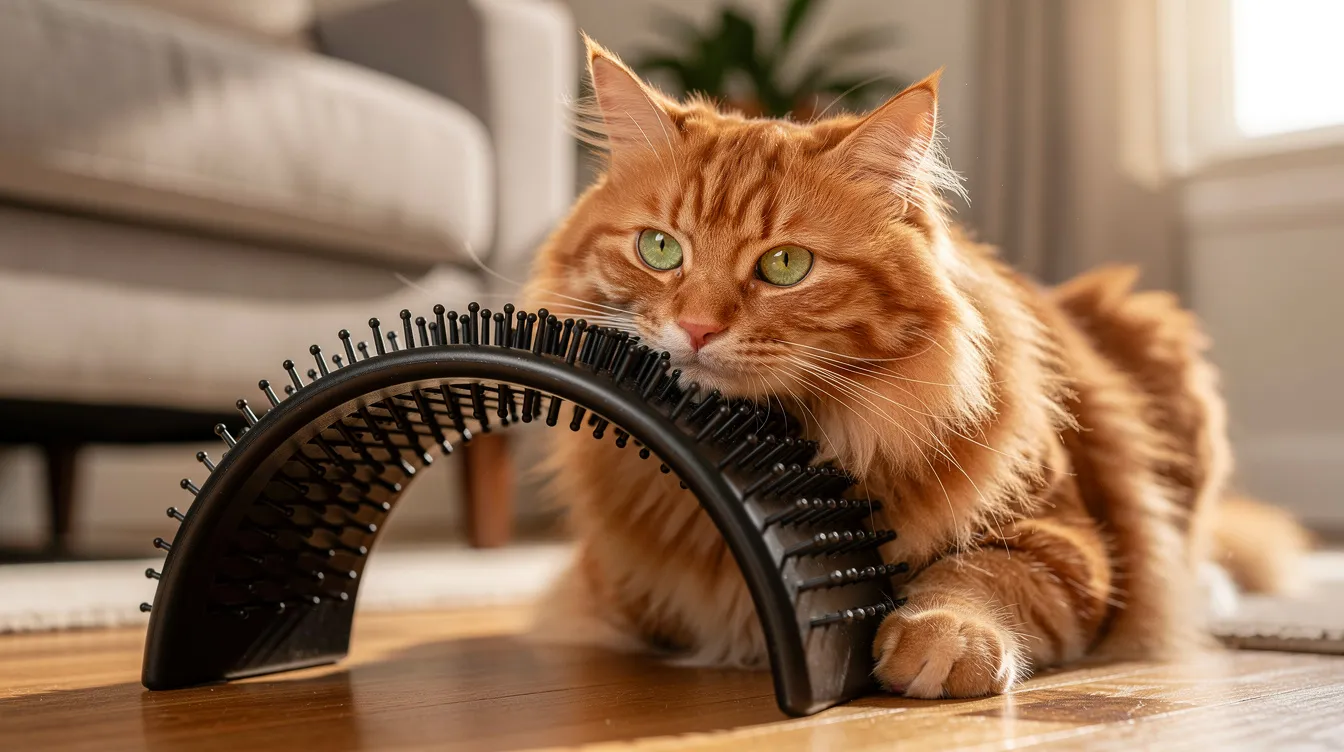
1. Cat Grooming Arch - Best Overall for Most Cats
A cat arch self groomer is a curved self grooming arch with flexible bristles mounted on a stable base, often including a scratch pad, and many cats also use that base to work their claws between rubbing passes. Cats walk under it, lean sideways, and rub along the full arch for hands-free full body contact.
Why it works:
- Covers cheeks, chin, neck, shoulders, sides, and back in one pass
- Cat-controlled pressure and angle
- Combines grooming with cat scratching and stretching
- Works well for indoor cats left alone during work hours
- Cat arch scratchers remove loose hair and dander effectively
- Promoting physical engagement in indoor cats supports mental stimulation and comfort
Honest drawbacks:
- Requires some floor space (not ideal for very tight rooms)
- Cheap versions with light bases can tip during vigorous play-a stable base prevents tipping
- Timid cats may need patient introduction over days
Self-groomers also help distribute natural skin oils across a cat's coat, keeping fur healthier between manual brushing sessions.
If your cat is a "furniture rubber" or "leg weaver," shop the Cidero Self-Grooming Cat Arch Toy → or compare it with other cat arch scratchers for stretch-loving cats.

2. Corner-Mount Cat Brush - Best for Cats That Rub Corners
Corner brushes clip or screw onto the edge of a wall or piece of furniture, turning that wall edge or furniture edge into a fixed grooming post where your cat already rubs.
Pros:
- Minimal floor footprint
- Easy to install at cheek height
- Affordable and quick to test
- Great for narrow hallways and doorway corners
Cons:
- Limited contact area-mainly cheeks and sides
- Can be ignored if placed too low or too high
- Adhesive pads may loosen over time
- Less versatile than a freestanding grooming arch
A corner brush can complement, not replace, a grooming arch for cats that also enjoy stretching and back rubs.
3. Wall-Mount Cat Groomer - Best for Small Spaces
Wall-mounted groomer cat massager panels sit flat against a vertical surface, offering slightly more coverage than a corner brush while taking up zero floor space.
Pros:
- Always accessible along a regular walking route
- Tidier than a large base-and-arch in very tight spaces
- Wall-mounted groomers turn natural scent-marking behavior into grooming sessions
Cons:
- Depends heavily on correct installation height
- Less freedom of movement than a freestanding arch
- Usually doesn't include a scratch pad or toy element
Best for: slim apartments, studios, or households that keep floors clear. Some owners pair a small wall groomer with enrichment toys like interactive lamps or multi-cat cat tunnels for a more complete setup.
4. Brush Mat - Best for Cats That Like to Roll
A brush mat is a flat pad with integrated soft nubs or short bristles that lies on the floor, designed for cats that prefer lying down and rolling.
Pros:
- Floor-level, easy to place next to a window perch or bed
- Ideal for older cats-self-groomers assist older cats with mobility issues who can't easily reach an arch or wall brush
- Can collect some loose fur during rolling sessions
Cons:
- Less full body pressure than a grooming arch
- Collects dust and litter; harder to keep clean
- May slide without non-slip backing
- Doesn't satisfy cats that prefer vertical rubbing
Brush mats work well as a secondary option in multi-cat homes where one cat loves an arch and another prefers softer, floor-level stimulation. For more on senior cat enrichment, self-groomers can assist older cats who have trouble reaching certain spots.
Grooming Arch vs. Corner Brush vs. Wall Groomer vs. Brush Mat
Match your cat's habits to the right format:
|
If Your Cat… |
Choose |
|---|---|
|
Rubs against furniture or legs |
Grooming arch |
|
Loves rubbing door frames and corners |
Corner brush |
|
Frequently rubs along walls |
Wall groomer |
|
Rolls around on the floor |
Brush mat |
|
Likes full body rubbing and stretching |
Grooming arch |
|
You want a dedicated grooming station |
Grooming arch |
|
You have very limited floor space |
Wall or corner groomer |
|
You have multiple cats with different habits |
Arch + secondary groomer |
Choose the format first. Smaller differences like color, added toys, or price should come after you've matched the right style to your cat.
Do Cat Self Groomers Actually Reduce Shedding?
No self groomer will stop your cat from shedding. But the right one can catch loose fur before it reaches your couch, clothes, and bed.
Cat arch self groomers can reduce shedding effectively by lifting out excess hair during repeated cheek, neck, and side rubs. Daily grooming reduces hairballs by limiting the amount of loose fur ingested by cats. A grooming arch can help reduce hairballs, and self-grooming tools help reduce the overall volume of loose hair in homes over time.
That said, self groomers are supplements, not replacements. Heavy shedding breeds and long-haired cats still need regular human brushing. Slicker brushes effectively catch loose fur and help prevent mats in fur for those breeds. Short-haired indoor cats usually see the biggest difference from consistent self grooming sessions. Expect results over weeks, not days.
Will My Cat Use a Self Grooming Toy Without Me?
Self-grooming tools allow cats to brush themselves passively throughout the day. Many cats will use a well-placed grooming arch spontaneously after a gentle introduction, especially if it's near a route they already walk or a spot they already rub.
Stability and texture matter most. Wobbly bases or very scratchy bristles put cats off, while sturdier bases and balanced bristle softness encourage repeat visits. Some cats engage within minutes; others may take days to casually test. Both responses are normal and mirror the reasons some cats seem to ignore toys entirely. For more tips on passive enrichment, read how to entertain a cat when you're not home and explore additional ways to keep your cat entertained while you're away.
How to Get Your Cat to Use a Self Groomer
Most cats can be encouraged with thoughtful placement and patience, especially when self-groomers are part of a broader indoor cat enrichment plan:
- Place it where your cat already walks or rubs - not in an unused corner
- Let them sniff and investigate - use treats or catnip to gently guide the head toward the arch, but never force their face or body against it
- Add scent cues - use catnip to encourage cats to use self groomers, or try silver vine on the bristles or scratch pad; catnip or silver vine is often incorporated into self-grooming tools to attract cats
- Reward curiosity - treats can help build positive associations with self groomers
- Adjust the bristle angle if your cat seems unsure about pressure or contact
- Give it time - check again after a few days, and try moving the arch a meter or two if it's being ignored
Keep the grooming arch in a permanent spot for frequent use. Packing it away between sessions removes the familiarity cats need.
Are Cat Self Groomers Safe?
Well-made self groomers are generally safe for unsupervised use when stable, intact, and checked regularly.
Key safety checks:
- Weighted, non-slip base for arches-a stable base prevents tipping during vigorous play
- Secure mounting hardware for wall and corner groomers
- Smooth, flexible bristles without sharp or broken tips
- No loose small parts that could be chewed off
Inspect weekly for bent bristles, loose screws, or fraying scratch pads. Kittens, seniors, or cats with skin conditions may need softer bristles and shorter initial sessions, just as they do with other enrichment toys that require safety checks. Replace any tool with frayed or broken components promptly.
Best Cat Self Groomer for Multi-Cat Households
In multi-cat homes, each cat may prefer a different format. One may love a cat arch self groomer while another only uses a corner brush.
A single sturdy grooming arch with full body access often works as the main station. Place secondary tools-a corner groomer, brush mat-in other rooms, and spread out other pet supplies to reduce competition and resource guarding so the home feels calmer for the whole cat family. Self-grooming tools can help moderate tension by giving each cat a place to scent-mark and de-stress, especially when paired with tunnels and interactive toys or other cat toys and accessories.
Our Pick: The Self-Grooming Arch Toy
For most indoor cats that enjoy rubbing furniture or people, a high-quality grooming arch is the best cat self groomer to try first. The Cidero & Co. cat arch self groomer is our top pick because this product stands out for enrichment, stability, and cat-controlled grooming rather than aggressive deshedding.
A grooming arch can help prevent hairballs in cats, and arch scratchers reduce cat hair on furniture and floors when used consistently. Self-groomers can reduce cat hair on furniture significantly over weeks of daily use, especially when combined with behavior-focused kicker toys that redirect excess energy.

Why We Picked the Arch
The grooming arch scores best across every buying criterion: body coverage, likelihood of use, enrichment value, ease of cleaning, and safe unsupervised use. Unlike a traditional cat brush, it lets cats initiate grooming themselves throughout the day, turning brief walk-bys into quick sessions.
The arch format naturally supports full body rubbing, stretching, and massage while catching loose fur on cheeks, chest, and flanks. Compared to a single wall groomer or corner brush, a well-designed arch offers more flexibility in placement and interaction.
Who Should Buy It?
Good fit if your cat:
- Rubs against chair legs or door frames
- Leans into your hand for cheek scratches
- Stretches while walking under furniture
- Leaves visible cat hair on sofa edges
- Enjoys independent play and enrichment
May not be ideal if:
- Your cat hates any bristle contact
- Your cat rarely rubs against anything
- You're only looking for a deep deshedding tool
If your cat matches the "good fit" list, the Cidero & Co. grooming arch is likely the best first self-grooming purchase to add to your cart.
What Makes This Different From an Arched Cat Scratcher?
Not every arched cat scratcher is a scratching-first version of a true self groomer. Arched cat scratcher products are designed primarily around claw care and scratching texture, while a grooming arch focuses on bristle quality, contact coverage, and massaging feel.
Cidero & Co.'s grooming arch prioritizes flexible grooming bristles and a stable grooming posture, with scratching as a complementary feature. If you're hunting for a heavy-duty scratcher first, consult our Best Cat Arch Scratchers for Stretch-Loving Cats guide instead.
Frequently Asked Questions About Cat Self Groomers
What is the best cat self groomer?
For most indoor cats that lean into furniture and people, a grooming arch with flexible bristles offers the most versatile full body grooming. Corner brushes, wall groomers, and brush mats are strong alternatives when space or specific habits point in that direction.
Do self-grooming cat toys really work?
Yes, when placed where the cat already rubs and when the bristles are comfortable for repeated use. They can't replace thorough handheld brushing but can noticeably cut down loose fur on surfaces the cat contacts daily.
Do cat self groomers help with shedding?
They help by catching loose fur during natural rubbing, which can reduce visible cat hair on furniture and may lessen hairballs. Think of them as a complement to regular brushing, especially during heavy shedding seasons.
What is a cat grooming arch?
A cat grooming arch is a freestanding curved arch of flexible bristles attached to a base, often with a scratch pad. Cats walk through or rub along it for hands-free brushing and massage across their cheeks, neck, shoulders, and sides.
Is a cat grooming arch better than a corner brush?
A grooming arch is typically better for cats that enjoy full body rubbing and stretching. A corner brush is better for cats that specifically target door frames or cabinet corners. Choose based on your cat's current rubbing habits, not on price alone.
Will my cat use a self-grooming toy automatically?
Some cats start within minutes; others need days or weeks. Correct placement, stability, and scent cues like catnip significantly increase the chance of success. Slow adoption isn't failure-cats often take time to fully adopt new enrichment items.
Are self-grooming toys safe for cats?
Self-grooming toys are generally safe when made from pet-safe, durable materials with securely fixed parts and smooth bristles. Supervise first use, then perform quick weekly checks for damage. Replace any tool with frayed or broken components promptly to protect your cat's skin. If you have pre-purchase questions or feedback, contact support in the comments before buying.
Final Verdict - Which Cat Self Groomer Should You Buy?
|
Category |
Winner |
|---|---|
|
🏆 Best Overall |
Grooming Arch |
|
Best for Corners |
Corner Brush |
|
Best for Small Spaces |
Wall-Mount Groomer |
|
Best for Floor Rollers |
Brush Mat |
If your cat naturally rubs against furniture, your legs, corners, or anything else they can find, the grooming arch is the format to try first. Choose based on your cat's habits, then factor in apartment size, cleaning preferences, and money.
For a sturdy, enrichment-focused cat arch self groomer designed to match how your cat already moves, the Cidero & Co. arch is the most sensible first purchase.


