

Best Automatic Cat Toys for Indoor Cats: What’s Worth the Money? (And What’s a Waste)
There isn't one "best" automatic cat toy for every indoor cat. The right one depends on how your cat already plays - whether they stalk, bat, chase, or leap - and the wrong one just becomes expensive furniture. Some cats won't benefit from automation at all.
This guide breaks down the best automated cat toys by movement style, explains the trade-offs nobody puts on the box, and helps you figure out which type actually fits your cat's play style before you spend the money.
Quick answer: Which automatic cat toy is actually worth buying?
Automated toys use electronic movements and smart sensors to mimic real prey - rolling, popping up, fluttering, or projecting light across a floor. The category is broad, and different things work for different cats. Here's how the main types compare:
|
Toy Type |
Best For |
Main Advantage |
Biggest Drawback |
|---|---|---|---|
|
Rotating / ambush |
Cats who stalk and pounce |
Surprise + disappearing movement |
Can become predictable if pattern is rigid |
|
Spinning feather |
Cats who love batting and chasing |
Continuous movement in a compact area |
Repetitive if the motion doesn't vary |
|
Laser toy |
Cats who chase moving light |
High visual engagement, big coverage |
Nothing physical to catch |
|
Rolling ball |
Active cats who sprint across floors |
Covers more territory in the home |
Gets stuck, can be loud on hard floors |
|
Fluttering / butterfly |
Prey-driven cats attracted to airborne motion |
Natural-looking, erratic movement |
Moving parts wear out faster |
For most cats, a rotating or ambush toy plus a spinning feather - combined with one or two good manual toys like a wand toy or a kicker toy - is a stronger starting setup than buying every electric cat toy on Amazon. Automated toys can offer variety in play styles to keep cats interested, but they work best as part of a rotation, not a one-and-done solution.
At Cidero & Co., we design automatic toys as tools for mental stimulation and independent play - not replacements for the ten minutes you spend dragging a wand across the floor while your kitty goes wild. They're meant to fill gaps, not replace you.
What makes an automatic cat toy actually worth buying?
Unlike a simple catnip mouse or a ball of crumpled paper, electronic and battery powered cat toys live or die on three things: how they move, how they sound, and how long they last before you're hunting for new batteries. These are the criteria we use at Cidero & Co. when deciding which interactive toys to design or recommend - and they're the same criteria that should guide your buying decisions.
Unpredictability: the #1 feature for keeping a cat entertained
Cats respond best to automated toys with unpredictable movements that resemble hunting. Once your cat can predict the toy's next move, it stops being prey and starts being background noise.
The features that create genuine unpredictability:
- Changes of direction (not just a perfect circle)
- Pauses - the toy stops, then darts again
- Varying speed within the same session
- Disappearing and reappearing play (peekaboo mice, tunnel openings)
- Irregular arcs for feathers or butterflies
Compare a simple spinning circle toy - same speed, same path, same everything - with an ambush toy that sometimes pauses, sometimes darts from a different opening. The circle toy is interesting for about a day. The ambush toy can hold attention for weeks because the cat can't quite figure out where the "prey" will appear next.
A 2026 citizen science study tracking 87 indoor cats found that interest in a moving feathered object declined significantly across repeated trials (p = 0.002), even though individual cats were consistent in their play styles. The takeaway: even good movement gets stale without variation. Unpredictable movements are non-negotiable.
Noise: when electronic toys scare more than they entertain
Motor noise, clicking, and plastic rattle are a deal breaker for many sound-sensitive cats, especially in small apartments. Common noise culprits include:
- Electric motors with loud gear reduction
- Hard plastic housings vibrating on hardwood or tile floors
- Battery doors and screws rattling during motion
- Cheap gear clicks during direction changes
Reviews for popular ambush-style toys frequently mention cats being "scared for days" by mechanical sounds. A toy that's fine in a busy family room can be genuinely too loud for a studio apartment at night. Always check honest reviews for "too loud" complaints before buying toys for sensitive cats.
At Cidero & Co., we prioritize quieter drive systems and softer materials where possible - but we'd also tell you that no motor-driven toy is truly silent.
Battery life and power modes
The best automated cat toys balance engagement time with not burning through AAA batteries every week. Key power details worth checking before you buy:
- Battery type: disposable (AA/AAA) vs. USB-rechargeable lithium-ion
- Run-time ranges: many spinning feather toys run roughly 10–15 minutes per charge; rolling balls vary widely
- Auto shut-off: timers that stop the toy after a set session (usually 8–15 minutes) to conserve power
- Motion activated vs. always-on: motion activated modes save battery life and can re-engage the cat when they walk past
- Secure battery compartments: always check that compartments close firmly to prevent accidents, especially with kittens
Some toys require batteries that drain fast under continuous use. USB-rechargeable options are increasingly standard in higher-end models and save money over time. Keep spare rechargeables handy, and don't leave automatic toys whirring all day - short sessions are better for your cat and your power bill.
Actual play value (does your cat WANT to use it?)
An electric cat toy that moves but doesn't invite stalking, pouncing, or batting is just noisy decor. Toys should be made from safe, non-toxic materials and durable enough to withstand biting, chewing, and licking - but durability means nothing if the cat walks past it.
Signs of genuine play value:
- Your cat returns to the toy repeatedly across multiple days
- Full-body engagement: ears forward, tail up, crouch-and-pounce sequence
- Varied behaviors - batting, chasing, bunny-kicking, watching
- The toy encourages physical fitness by stimulating cats to chase and pounce
Contrast a heavily advertised auto cat toy with hundreds of "my cat ignored it after two days" reviews against a simpler motion activated toy that keeps appearing in "still using it months later" feedback. The difference is usually whether the toy supports the cat's natural hunting behaviors - stalk, chase, pounce, catch - or just moves for the sake of moving.
Automated toys provide mental stimulation by challenging cats' cognitive skills and satisfying predatory instincts. That's the design philosophy at Cidero: start with the hunting sequence, then add automation in support of it.
The biggest problem with automatic cat toys: cats get bored fast
Many pet parents buy a pricey automatic toy expecting it to keep cats entertained indefinitely, only to watch it get ignored within a week. Here's how it typically goes:
Day 1: The cat is glued to it. Ears pinned, pupils wide, full predator mode. You feel like a genius.
Day 3: Still engaged, but sessions are shorter. The cat knows the toy is there and checks in when the mood strikes.
Day 7: The cat walks past it. Maybe gives it a glance. You move it to a different spot. Five minutes of interest, then nothing.
This isn't a quality problem - it's habituation. Cats are natural hunters and need toys that simulate hunting, but once they understand that something always moves in the same direction, at the same speed, from the same location, it stops being "prey" and becomes furniture. Cats can get bored after ten minutes of play even with a good toy. Bored cats may develop undesirable behaviors like scratching furniture, over-grooming, or yowling - exactly the problems you bought the toy to prevent.
Practical ways to fight habituation:
- Rotate toys weekly - store some out of sight so they feel new again
- Change locations (bedroom one week, hallway the next)
- Use short 5–15 minute sessions instead of leaving toys on all day
- Pair automated toys with manual wand or cat dancer sessions for variety
- Combine different things: a puzzle feeder one day, an automatic toy the next
A small rotation of high-quality interactive toys is better than a basket of rarely used gadgets. Automated toys can reduce boredom and stress in indoor cats, especially when combined with the best toys for bored indoor cats, but only if you manage how and when they appear.
Rotating and ambush automatic cat toys
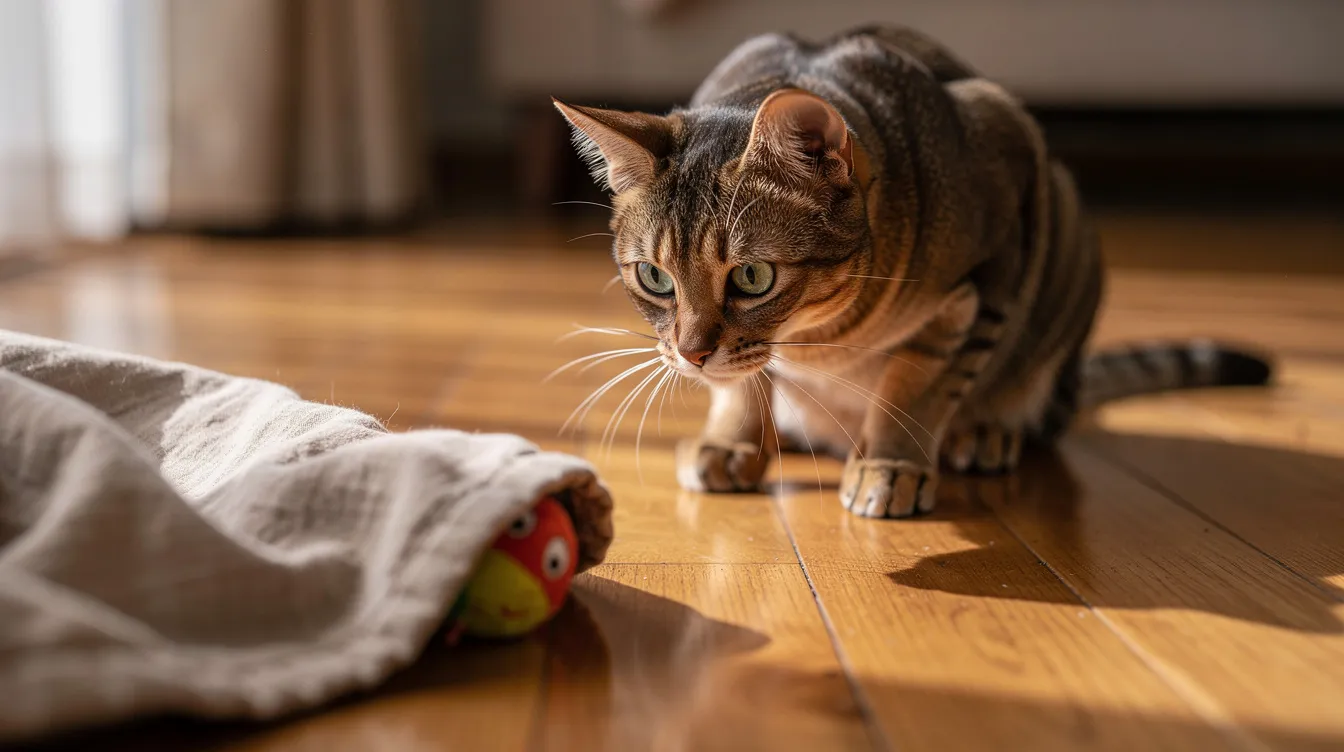
This category includes toys where movement appears from under or behind something - cheese blocks with popping mice, discs with hidden wands under fabric skirts, peekaboo tunnel openings - and then disappears again. The intermittent visibility triggers stalking and pouncing behaviors.
These are often among the best toys for cats who love hiding under blankets, watching from behind furniture, or ambushing your ankles. The hide-and-seek motion taps directly into the stalk-and-pounce sequence that makes cats feel like they're actually hunting.
The PetSafe FroliCat Cheese, for instance, features mice that pop in and out of holes in a wedge-shaped base, and it comes with a two-year manufacturer's warranty - a sign the company expects it to take a beating. It's a good example of the category, similar in spirit to an automatic peekaboo cat toy designed for independent ambush play.
The failure mode: if movement always appears at the same hole or follows a rigid pattern, cats figure it out fast. Some cheaper models use the same noise, the same speed, and the same timing every cycle. Reviews for popular ambush toys frequently mention that cats lose interest once the pattern becomes obvious.
Cidero & Co. Peekaboo: example of an ambush-style toy
The Peekaboo is Cidero's take on ambush play for indoor cats that like to stalk and pounce - not a universal "best cat toy," but a strong fit for a specific play style.
- Prey-like motion that disappears and reappears at varied intervals
- Soft, furniture-friendly materials with no sharp edges for safety
- Quieter drive than many plastic disk toys
- Auto-off cycle designed for short, intense play rounds
What it isn't ideal for: highly active cats that want to chase toys across the entire room, or cats that only respond to airborne toys like butterflies and birds. For those cats, keep reading.

Spinning feather automatic cat toys
Battery powered bases that spin a feather or lure in circles or arcs, encouraging batting and short chases around a fixed point. SmartyKat Loco Motion spins a feather to engage cats and is one of the better-known examples. Typical features include adjustable speeds, interchangeable feather heads, and motion activated or timer-based movement modes.
This style suits cats that love wand toys but will happily stand, reach, and bat without needing the toy to travel far. It's a great choice for small apartments and "lazy hunters" who enjoy the game but don't need to sprint.
If the rotation is perfectly smooth and constant, though, some cats will treat it like a ceiling fan - interesting once, boring after. Look for models where the feather path varies slightly rather than tracing a perfect circle every time. Also check that feathers are securely attached; detachable small parts can be choking hazards.
Cidero & Co. Interactive Hunting Spinner
The Interactive Hunting Spinner is Cidero's entry in the spinning feather category, built for cats that love to bat and circle a moving target. For a deeper look at features like adjustable speeds, realistic sounds, and USB charging, see the Hunting Spinner exercise toy for indoor cats.
- Sturdy base that doesn't tip easily when paws hit it
- Feather paths that vary instead of a perfect circle
- Action stays contained in a safe, central play zone
Limitations: not ideal for cats who demand long-distance chases across the house, or for those who quickly lose interest in circular motion and need more erratic patterns. It isn't a substitute for a human-led wand session when your cat wants a more unpredictable chase - and we'd rather tell you that upfront than have you disappointed.

Laser automatic cat toys
Automatic and motion activated laser toys - floor units, wall-mounted projectors, dome-style devices - cast a moving dot across walls and floors without you lifting a finger. Many cats go absolutely crazy for them: fast, unpredictable motion covering an entire room is catnip for visually driven cats.
The key limitation is serious: there is nothing to physically catch. The play sequence is incomplete. Cats that chase a laser for five minutes without ever "catching" anything can become frustrated or over-aroused. Finish every laser session with a tangible toy or treat so the cat gets the satisfaction of a real catch.
Safety matters here. Never shine lasers directly into a cat's eyes - or the eyes of humans, dogs, or small pets in the house. The FDA recommends using only Class 1 toy lasers, which are the lowest risk category. Limit sessions to brief spurts, and skip lasers entirely for cats that show signs of frustration or obsessive behavior.
Laser toys are an occasional mental stimulation tool, not a core exercise solution. Pair them with toys that allow a full stalk-chase-pounce-catch sequence.
Rolling automatic balls and chase toys
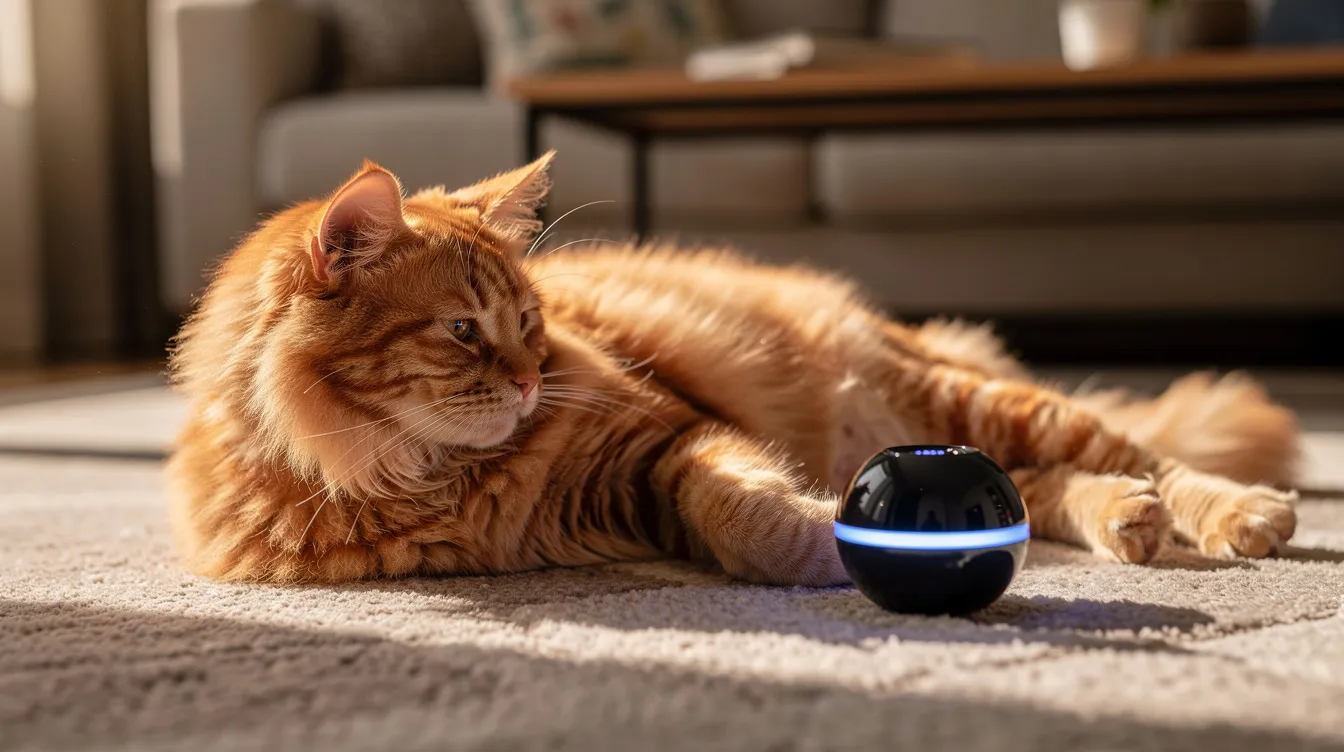
Battery powered or rechargeable balls and egg-shaped toys that roll, wobble, or zig-zag across the floor - sometimes motion activated so they spring to life when your cat walks past. The Cheerble M1 Smart Toy reacts to your cat's movements, adjusting its rolling path dynamically. The Cheerble light-up ball provides up to four hours of play on a single charge, which is considerably longer than most spinning feather toys.
Benefits are clear: balls roll across territory, encourage longer chase sequences, and engage cats that love floor-level sprinting. These toys can keep high-energy cats occupied and prevent destructive behaviors - ideal for young, active cats and kittens that need more exercise.
Common failure points from reviews:
- Getting stuck under couches and furniture (a frequent complaint)
- Overly loud plastic shells on hard floors
- Fragile shells that crack after a few weeks
- Predictable rolling patterns on smooth surfaces
These aren't ideal for arthritic senior cats or very timid cats who may find fast-moving objects terrifying rather than fun. For those cats, a slower, gentler option or even a non-electronic kicker toy is often a better fit.
The Enabot ROLA PetPal features a built-in camera and two-way talk, putting it in a premium niche between "toy" and "pet monitor." It's a different category entirely from a simple rolling ball, and the price reflects that.
Fluttering and butterfly-style electronic toys
Vertical bases with a wire "stem" holding a butterfly, bird, or moth that flutters and spins when powered on. These can make cats jump, leap, and watch intently - the erratic flutter and mid-air movement resemble genuine prey like moths at a window.
Why many cats find them irresistible: the movement is inherently irregular, closer to how a real insect moves than any perfect-circle spinner. Cats that track birds outside, chase shadows, or pounce at flies tend to respond strongly.
Trade-offs exist:
- Determined cats will chew or break exposed wire stems
- The wire can bend permanently after vigorous play
- Feathers and wings wear out and need replacing
- Supervise especially vigorous players - this isn't a "leave it running" toy
Best for high-prey-drive cats that prefer leaping and mid-air catches. Not ideal for cats who only engage with ground-level toys or who are frightened by vertical, fluttering motion.
Cidero & Co. Fluttering Butterfly
The Fluttering Butterfly is Cidero's airborne prey toy, designed to mimic shaky, unpredictable insect flight rather than a smooth spin. For more details on this Fluttering Butterfly Cat Toy and enrichment features, including USB charging and safety notes, see its full product page.
- Replaceable butterfly attachments so you're not buying a whole new toy when parts wear
- Quieter motor than many budget models
- Stable base that resists tipping during aggressive play
Drawbacks: not suited to cats that instantly shred delicate parts, may need supervised sessions, and doesn't provide much ground-level chasing. If your cat's preferred play is floor-level stalking, an ambush-style toy will serve them better.

Automatic cat toy comparison: movement, noise, and play style at a glance
This table pulls together the major toy types so you can compare them without scrolling back through every section.
|
Toy Type |
Movement Pattern |
Unpredictability |
Typical Noise |
Best For |
Main Drawback |
|---|---|---|---|---|---|
|
Rotating / ambush |
Appears and disappears |
High (if randomized) |
Low–medium; quiet hum to noticeable click |
Stalkers and pouncers |
Predictable if pattern is rigid |
|
Spinning feather |
Circular or arc |
Medium |
Low–medium; motor whir |
Batters and short chasers |
Repetitive circular path |
|
Laser |
Light projection |
High |
Low; near-silent |
Visual chasers |
No physical catch |
|
Rolling ball |
Floor travel |
Medium–high |
Medium–high on hard floors |
Active sprinters |
Gets stuck; can be loud |
|
Fluttering butterfly |
Erratic vertical flutter |
High |
Low–medium |
Prey-driven leapers |
Moving parts wear out |
Noise and battery life vary enormously between brands - avoid trusting exact numbers from marketing pages. The Catit Groovy Fish, for example, has a refillable catnip pocket and isn't really an "automatic" toy in the motorized sense, but gets lumped into the same "best electronic cat toy" lists. Similarly, the Catit Pixi Spinner occupies a different niche from a true ambush toy. Read reviews, watch videos of real cats using the product, and match movement style to your own cat's preferences rather than chasing Amazon's Best Sellers list.
How to choose an automatic toy for your cat's play style
The most important question isn't "What is the top rated cat toy?" It's "How does my cat already like to play?"
Watch your cat for a few days. What they do with existing cat toys, cardboard boxes, and even crumpled paper tells you everything:
- Stalks things under blankets or behind furniture → Try an ambush or peekaboo-style toy
- Loves batting at wand feathers → Try a spinning feather toy
- Sprints after anything that moves across the floor → Try a rolling ball
- Goes crazy for birds and flying insects at the window → Try a fluttering butterfly toy
- Chases reflections and light spots on the wall → Consider a laser (with limits)
Different movement styles in toys can accommodate individual cat preferences and natural hunting behaviors. Don't assume what worked for other cats will work for yours.
In multi-cat households, different personalities may benefit from entirely different automatic toys. One cat might love the ambush style while the other only responds to rolling chase toys. Putting out the same toys for all cats often means one cat plays and the others walk away.
For very timid or senior cats, slower, gentler motion - or even non-electronic options like a simple kicker toy - may be more appropriate to keep the cat happy and confident rather than stressed.
How to keep automatic cat toys interesting over time
Toy rotation helps maintain a cat's interest and excitement more than any single "best" product can. The research is clear: interest declines with repetition, no matter how good the toy is. Here's your maintenance plan:
- Rotate weekly: keep 2–3 automatic toys in use and store the rest. When you bring one back after a week away, it feels new again.
- Change locations: move the toy from the living room to the hallway, or from the floor to near a window perch. Different surfaces (rug vs. hardwood) change how the toy moves and sounds.
- Vary timing: don't activate the same toy at the same time every day. Surprise matters.
- Pair auto with manual: alternate between automatic sessions and human-led wand or cat dancer play. Humans are better at reading a cat's energy and adjusting.
- Add non-electronic enrichment: indoor enrichment ideas include puzzle feeders, tunnels, cardboard boxes, scratching posts, and food-dispensing toys for active engagement alongside automatic toys.
Aim for 10–15 minutes of automatic play once or twice a day rather than leaving devices running continuously. Short sessions prevent habituation, save battery life, and avoid overstimulation.
This reflects Cidero & Co.'s broader mission: sustainable mental stimulation and physical activity for indoor cats without constant noise or overreliance on gadgets. New toys are fun, but a smart rotation of best products you already own is more effective.
Our automatic cat toy picks from Cidero & Co.
These aren't ranked #1, #2, #3. They're examples of each movement style, designed for specific play behaviors. Choose based on how your cat plays, not on which one looks most impressive.
Peekaboo - Ambush style
- Best for: cats who stalk, watch, and pounce on appearing/disappearing targets
- What it does well: creates surprise through varied timing and appearance points; furniture-friendly materials; quiet enough for apartment playtime
- What it isn't best for: cats who need long chase sequences across the room
Interactive Hunting Spinner - Spinning feather style
- Best for: cats who love batting and circling a moving feather target
- What it does well: keeps action concentrated in a central area; sturdy base; feather paths that vary
- What it isn't best for: cats who need room-spanning movement or who lose interest in circular motion
Fluttering Butterfly - Airborne prey style
- Best for: cats attracted to erratic flying or fluttering movement
- What it does well: mimics insect flight; replaceable attachments; quieter motor
- What it isn't best for: ground-level stalkers or cats that destroy delicate parts quickly
Most indoor cats benefit from owning at least one automatic toy and one simple interactive toy - a wand, a kicker, or even a crumpled paper ball - to round out their playtime. Automated interactive toys enable independent play for cats, especially when owners are unavailable, but they encourage the most engagement when they're part of a broader routine.
Automatic vs. interactive: which type of cat toy does your indoor cat actually need?
Some experts are skeptical of automatic interactive cat toys. Others see them as a helpful supplement for busy owners. Both positions have merit.
Automatic toys provide solo play, variety, and motion when you're at work or busy around the house. They encourage physical activity, can help prevent boredom, can simulate natural hunting behaviors, and can reduce stress for cats left alone. The downsides: batteries, motors that fail, repetitive movement that becomes boring, and the fact that no gadget reads your cat's energy the way you can.
Interactive and manual toys - wands, cat dancers, play fetch sessions with small toys - offer responsive, unpredictable play and genuine bonding. You control the pace, you watch for over-arousal, and you can end the session with a satisfying "catch." The downside: they require your participation. Every time.
Automated toys are best viewed as supplements to interactive play, not replacements for it. They should never encourage unsafe behaviors like chasing hands or feet. Choose toys that promote both physical and mental stimulation, select toys made from safe, non-toxic materials for durability - and where possible, opt for toys made from plant-based materials like hemp or cotton for attachments and covers.
A realistic setup for most indoor cats: one or two high-quality automatic toys plus daily 10–15 minutes of wand or interactive play. That keeps most cats engaged, healthy, and far less likely to redecorate your house with claw marks.
At Cidero & Co., our collection is designed to fit into a larger enrichment routine that includes comfort items, feeding puzzles, and human interaction - not to replace any of those things.
FAQ: automatic and electronic cat toys
Are automatic cat toys good for indoor cats? Yes. Automated toys provide mental stimulation for indoor cats and encourage physical activity, helping prevent the boredom and stress that come from a low-stimulation environment. They're most effective when rotated regularly and combined with human-led play. Toys should have no sharp edges for safety and be made from durable, non-toxic materials.
Do cats get bored of automatic toys? Most cats do. Habituation is real - cats can get bored after ten minutes of play, and interest typically declines over days if the same toys stay in the same spot. Rotating toys, changing locations, and using short sessions helps. Automated toys provide mental stimulation and physical activity, but they need management.
Are battery powered cat toys safe? Generally yes, provided you check for secure battery compartments, avoid toys with small detachable parts that could be swallowed, and supervise initial sessions. Toys with exposed feathers or wires should be monitored. Always look for non-toxic, food-grade materials - especially for cats that chew.
How long should an automatic toy run? Most experts recommend sessions of 5–15 minutes rather than leaving toys on continuously. Many quality automatic toys include auto shut-off timers in this range. Short bursts prevent habituation, conserve battery life, and keep play feeling fresh. Interactive toys should simulate natural hunting behaviors with brief, intense sessions.
What is the best automatic cat toy for a bored indoor cat? Start by watching how your cat plays. Cats that stalk and pounce often respond to ambush-style toys. Cats that bat and swipe enjoy spinners. Active chasers prefer rolling balls. Cats that jump for insects may love fluttering toys. There's no single best electronic cat toy - only the right match for your cat's preferences.
Do automatic toys replace interactive play? No. They supplement it. A wand session where you control movement, speed, and pauses will always be more engaging than any motor-driven toy. Automatic toys fill gaps when you're busy, but they aren't a substitute for the enrichment that comes from playing with your cat directly.
Are motion activated toys better than always-on? For most cats and most households, yes. Motion activated toys conserve battery, create surprise when the cat approaches, and avoid the "always spinning so it becomes background noise" problem. They also won't wake you up at 4 AM - a common complaint with always-on rolling ball toys.
Automatic toys are only one piece of keeping an indoor cat engaged. For a broader enrichment approach - including tunnels, puzzle feeders, and sensory toys - explore the full Cidero & Co. enrichment collection.


